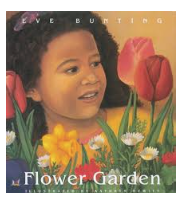
Flower Garden, Eve Bunting

           This is a wonderful book about spring and a little girls gift to her mother.  It is inspiration to those who live in the city and a reminder of the joy that plants bring to people everywhere.

Materials;

  • Silk flowers (these can often be gotten at craft stores for a few dollars. If they do not have stems, cut pipe cleaners into 6-8 inch pieces and attach to the silk flower heads.)
  • Petal Power game
  • Gardening catalogs or spring fliers from local garden stores
  • At least one real flowering plant

Vocabulary

  • Trowel ( a shovel for planting flowers or vegetables)
  • Jamboree ( a celebration, in the story it is a celebration of colors!)

Before reading the Story

            Show the children the cover of the book.  Ask them if they have ever helped plant a garden before?  Where do you get the plants?  What did you have to do to make the garden? What do you have to do to take care of the garden?  If you live in the city, this might be more difficult for the children to answer.  In that case, talk about if they have ever seen a flower garden?  Did you like it?  What did you like/not like about it?  Where did you see the garden?

Science/Scientific Knowledge; expands knowledge of and abilities to observe, describe, and discuss the natural world, materials, living things, and natural processes.

Reading the Story

           As you read the story, ask who, what, where, when, and why questions.  (Where are the girl and her father going with the flowers, what are they going to do? Why are they lighting candles?  Whose birthday do you think it is? What time of year is this story taking place?)

Language Development/Speaking & Communicating; develops increasing abilities to understand and use language to communicate informations, experiences, ideas, feelingsw, opinions, needs, questions,; and for other varied purposes.

After Reading the Story

            Talk about the sequence of the story.  Where did the story start? (In the store), then where did they go? (On the bus).  Where does this story take place? (in the city).  Where did the girl live? (High in the building).  Who was the last one to come home?  What special day was it?  Does anyone know when their special birth date is?

Literacy/Book Knowledge & Appreciation; demonstrates progress in abilities to retell and dictate stories from books and experiences; to act out stories in dramatic play; and to predict what will happen next in a story.

Discovery

           Put the real flower/s into the center today.  Encourage the children to uses their senses to tell you about the flower.  Let the children take it out of the container so they can see the roots.  Talk about what a plant needs to live and grow (water, dirt, air, and sunshine). Encourage them to draw the plant showing the various parts, including the roots.

Science/Scientific Skills & Methods; develops growing abilities to collect, describe, and record information through a variety of means including discussion, drawings, maps, and charts.

Music and Movement

           Sing or chant, Dig a Little Hole

You dig a little hole Pretend to dig a hole

And you put the seed in. Drop a pretend seed into the hole

And you cover it with dirt, Use hands to cover pretend hole

And let the sun shine in. Arms over head to make a circle

You give a little water Wiggle fingers over hole to make rain

And keep it fed,

Pretty soon a little plant will show its head. Bring one hand up through the other

Language Development/Listening & Understanding; demonstrates increasing ability to attend to and understand conversations, stories, songs, and poems.

            Go through the motions of making a birthday cake with the children and then sing Happy Birthday.

Language Development/Listening & Understanding; demonstrates increasing ability to attend to and understand conversations, stories, songs, and poems. AND Approaches to Learning/Initiative & Curiosity; chooses to participate in an increasing variety of tasks and activities.

Blocks

            In the story, the girl and her father planted the flowers in a window box.  Encourage the children to build a long window box out of blocks.  If you have enough silk flowers/plants, you could add these to the block center today.

Approaches to Learning/Engagement & Persistence; demonstrates increasing ability to set goals and develop and follow through on them.

Art

            Give each child a piece of brown paper and tell them to pretend that this is their window box.  Put out gardening catalogs and let the children cut and glue what their window box would look like.

Physical Health & Development/Fine Motor Skills; develops growing strength, dexterity, and control needed to use tools such as scissors, paper punch, stapler, and hammer.

Library and Writing

            Encourage the children to make cards for family members, friends, or a staff person.  Show them how to fold the paper in half.  Encourage them to draw a lovely flower design on the front.  Open it up and you can help them write a message or they can write/scribble their own message.  Make sure they sign the card.

Literacy/Early Writing; develops understanding that writing is a way of communicating for a variety of purposes. AND Literacy/Early Writing; progresses from using scribbles, shapes, or pictures to represent ideas, to using letter-like symbols, to copying or writing familiar words such as their own name.

Sand and Water

            Add dirt to the table along with several garden trowels or shovels.  Add silk plants, or real plants for the children to pretend to plant.  Bring in several containers that the children can use for the garden box.

Creative Arts/ Dramatic Play; participates in a variety of dramatic play activities that become more extended and complex.

Dramatic Play

            Add silk flowers and a plastic vase ( a water bottle works) so the children can arrange some cut flowers for the table or counter.

Math and Manipulatives

           Play Petal Power.  Give each child a potted plant from the resource page.  Cut out a quantity of petals in various colors and place in the center of the table.  Take turns rolling the dice.  The child counts the number on the dice and takes that many petals from the pile and places on her circle.  Play until all the petals are used up. Use glue sticks as you play to make your pots part of a wall display afterwards.

Mathematics/Number & Operations; begins to use one-to-one correspondence in counting objects and matching groups of objects. AND Social & Emotional Development/Cooperation; develops increasing abilities to give and take in interactions; to take turns in games and using materials; and to interact without being overly submissive or directive.

Outdoor Play

            Look for signs of nature growing around your playground.  Help the children to name the plants that they see.  That is a Loblolly Pine, that is a Dandelion, that is Oregano.

Science/Scientific Knowledge; expands knowledge of and abilities to observe, describe, and discuss the natural world, materials, living things, and natural processes.

Transitions

            Show the children the page where the Mother sees her garden.  Ask the children if the Mother liked her present?  Ask the children what they would like to get their Mother for her birthday?

Approaches to Learning/Reasoning & Problem Solving; develops an increasing ability to find more that one solution to a question, task, or problem.

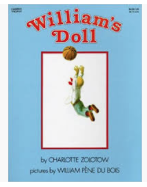
William’s Doll, Charlotte Zolotow

William wants a doll! His family thinks that there is something wrong with William. But his wise Grandmother buys William a doll and tells them all exactly why a doll is a perfect present for William.

Materials

  • Several pictures of babies.
  • Old toy catalogs.
  • Two or three bath towels and washcloths.
  • Medium sized box, basket, or garbage can

Vocabulary

  • Cradle (to make like a bed for the baby out of your arms)
  • Nonsense (it means that’s silly)

Before Reading the Story

Ask the children to describe some of their favorite toys. While discussing, ask the other children if it’s a toy they might like to play with also. Then ask is there any toys that only boys can play with or only girls can play with. If a child responds with a yes, ask them why they think that. Then steer the conversation to say that all toys are for all children.

Social & Emotional Development/Self-Concept; begins to develop and express awareness of self in terms of specific abilities, characteristics, and preferences.

Reading the Story

When you get to the part where William states he wants a doll, ask the children what they think about this? Can boys play with dolls, why or why not? What do you think will happen if William gets a doll for his birthday?

Science/Scientific Skills & Methods; begins to describe and discuss predictions, explanations, and generalizations based on past experiences.

After Reading the Story

Ask the children why they think it was good for William to get a doll for his birthday (so he can practice being a father). After a short discussion about what William did with his doll, take out a piece of paper and ask each child what they like to do with their father/father figure (My Dad takes me to get French fries. My Uncle John takes me to the park to swing on the swings. My biggerest brother gives me a ride on his bike).

Social & Emotional Development/Knowledge of Families & Communities; progresses in understanding similarities and respecting differences among people such as genders, race, special needs, culture, language, and family structures.

Discovery

Show the children pictures of babies. Ask them to think of things that they can do now that they could not do when they were a baby (I can ride a bike. I can eat crunchy food and my sister can only drink from her bottle).

Language Development/Speaking & Communicating; progresses in abilities to initiate and respond appropriately in conversation and discussions with peers and adults.

Music and Movement

When I was one year old,                          Children crouch down
I was very, very small                                 Put hands close together to show smallness
But now I’m 4 years old                              Hold up 4 fingers
And I’ve grown up big and tall!               Children stand up and put hands over head

Language Development/Listening & Understanding; demonstrates increasing ability to attend to and understand conversations, stories, songs, and poems.

Blocks

Add people and family props to the center. Encourage the children to build a home for the family/people. Ask them if they can add a window, a door, and a roof to their structure but praise any ‘house’ that they build.

Approaches to Learning/Reasoning & Problem Solving; grows in recognizing and solving problems through active exploration, including trial and error, and interactions and discussions with peers and adults.

Art

Put out old toy catalogs for the children to cut out toys they like for home and for the classroom (wish list).

Physical Health & Development/Fine Motor Skills; grows in eye-hand coordination in building with blocks, putting together puzzles, reproducing patterns and shapes, stringing beads, and using scissors.

Library and Writing

Ask the children to draw a picture of their father/father figure. What kinds of special things do you like to do with your father/father figure? Write their dictations on the bottom.

Literacy/Early Writing; begins to represent stories and experiences through pictures, dictation, and in play.

Sand and Water

Put warm water in the table today and let the children bath your classroom baby dolls. Give the children wash clothes and dish towels for drying and washing.

Social & Emotional Development/Knowledge of Families & Communities; develops growing awareness of jobs and what is required of them.

Dramatic Play

Parent play; add dolls, doll clothes, and any baby items you might have. Especially encourage the boys to use the dramatic center today.

Creative Arts/Dramatic Play; participates in a variety of dramatic plays activities that become more extended and complex.

Math and Manipulatives

Sorting bears or other sorters in small, medium, and large. Put out three bowls and encourage the children to sort by size. Call the small bears the babies, the medium bears the little sister/brother, and the biggest bears the big sister/brother. After they have sorted them, ask them to count how many of each they have in the bowl. Count along with them if they are beginner counters.

Mathematics/Numbers & Operations; develops increasing ability to count in sequence to 10 and beyond. ALSO Mathematics/Patterns & Measurement; shows growth in matching, sorting, putting in series, and regrouping objects according to one or two attributes such as color, shape, or size.

Outdoor Play

Give the children a small ball or bean bag to throw into a box, basket, or can. Have the children back up three paces and throw the ball into the container. As they take their turn, ask them to think of a word that starts with the letter sound of their name or any letters that you are working on (Can you think of a word that starts with the R sound like in your name Roger? Can you think of a word that starts with the letter S sound /s/s/s/). After a round, move back two more steps and continue in the same manner.

Literacy/Phonological Awareness; shows increasing ability to discriminate and identify sounds in spoken language.

Transitions

Ask the children to name family members as they go off to another activity. (Roger, what is your mother’s name? What is your big sister’s name?). Do they know the names of their parents? Do they know their own last name? If not, help them to practice naming these.

Social & Emotional Development/Knowledge of Families & Communities; develops ability to identify personal characteristics, including gender and family composition.

Dear Parent-Today we read the story William’s Doll. In it, William wanted a doll so that he could practice being a father. Talk to your child about some of the things you liked to do when your were their age. Ask your child what they like to do best at school; who do they play this with, or do they like to play this alone?

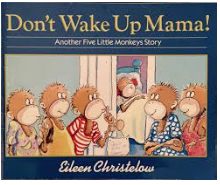
Don’t Wake Up Mama! by Eileen Christelow

Today is Mama’s birthday and 5 Little Monkeys want to do something special.  Follow the antics as 5 little monkeys prepare for a birthday surprise.

Materials

  •             Birthday hats and any other “party” supplies you may have.
  •             Pieces of wrapping paper.
  •             Cake mix plus ingredients needed and a can of cake frosting
  •             Birthday candles
  •             Metal bowl or cookie sheet.  

Vocabulary

  •             Quiet (not noisy)
  •             Loud (noisy)
  •             Surprise (to catch somebody unaware/unexpected)

Before Reading the Story

Before reading the story, talk to the children about how some sounds are loud and some sounds are soft.  Ask the children if they can help name some loud sounds and some soft sounds, write their responses onto a piece of paper labeled Soft Sounds/Loud Sounds (whisper, the tick of a clock, leaves falling down, fire alarm, airplane, thunder).  Show the children the front of the book, notice the 2 monkeys with their finger by their mother, what do you think they are saying?  Notice the Mama monkey, where is she?  What is she doing?  What are those things on her ears?  Ask the children to cover their ears, what does it do to the sound of your voice? Read the children the title of the book in a very quiet voice while putting your finger up to your mouth and saying shhhh.

Literacy/ Book Knowledge & Appreciation; shows growing interest and involvement in listening to and discussing a variety of fiction non-fiction and poetry.  AND Science/Scientific Skills & Methods; develops increased ability to observe and discuss common properties, differences, and comparisons among objects and materials.

Reading the Story

 Encourage the children to put their finger to their mouth and repeat, ”Shhh! Don’t wake up mama!” where appropriate.  Make the loud sounds loud while you read.

Literacy/Book Knowledge & Appreciation; shows growing interest and involvement in listening to and discussing a variety of fiction non-fiction and poetry.

After Reading the Story

Ask the children if they can tell you what the story was about.  Why did the monkeys not want to wake the Mama?  What did the monkeys make in the kitchen?  What happened to the cake?  Who came to help the monkeys?  What did they all do in the end?  Sing Happy Birthday very loudly with the children.

Literacy/Book Knowledge & Appreciation;demonstrates progress in abilities to retell and dictate stories from books and experiences; to act out stories in dramatic pay; and to predict what will happen next in a story.

Discovery

Put out a metal bowl and a variety of objects (feather, cotton ball, small block, crayon).  Ask the children to drop the items into the metal bowl and tell if it made a soft or loud sound.  Have the children make a chart, loud sounds and soft sounds by putting the dropped object on the appropriate piece of paper.

Science/Scientific Knowledge; expands knowledge of and abilities to observe, describe, and discuss the natural world, materials, living things, and natural processes. AND Science/Scientific Skills & Methods; develops growing abilities to collect, describe, and record information through a variety of means, including discussion, drawings, maps, and charts.

Today would be a fun day to let the children help make cake or individual cupcakes.  After they are baked and cooled, the children can use plastic knives to frost.

Language Development/Listening & Understanding; shows progress in understanding and following simple and multiple-step directions.  AND Physical Health & Development/Fine Motor Skills; develops growing strength, dexterity, and control needed to use tools such as scissors, paper punch, stapler, and hammer.

Music and Movement

 Sing Happy un-Birthday to Us.

Happy un-birthday to us

Happy un-birthday to us

Happy un-birthday happy un-birthday

Happy un-birthday to us.

            Or…

Happy birdel daydel todel youdel

Happy birdle daydel todel youdel

Happy birdle daydel happy birdel daydel

Happy birdel daydel todel youdel.

Literacy/Phonological Awareness; progresses in recognizing matching sounds and rhymes in familiar words, games, songs, stories, and poems.

Sing songs that change in voice modulation such as John Jacob Jingleheimer Schmidt or the Alphabet song.

Creative Arts/Music; participates with increasing interest and enjoyment in a variety of music activities, including listening, singing, finger plays, games, and performances.

Blocks

Add fire trucks and fire hats today.

Creative Arts/ Dramatic Play; shows growing creativity and imagination in using materials and in assuming different roles in dramatic play situations.

Art

On a piece of paper make a large M, for monkey and B, for birthday.  Show the children how to roll out the playdough or use pinches of play dough to cover the letters.  This can also be done with the letters in the children’s names.  Cover the name with contact paper if you would like to have it for an extended period of time.

Literacy/Alphabet Knowledge; shows progress in associating the names of letters with their shapes and sounds.

Library and Writing

Encourage the children to make cards to share with their parent or a friend.  It can be a un-birthday card or just a card to express love/friendship.  Help to dictate their words.

Literacy/Early Writing; develops understanding that writing is a way of communicating for a variety of purposes.  AND Physical Health & Development/Fine Motor Skills; progresses in abilities to use writing, drawing, and art tools, including pencils, markers, chalk, paint brushes, and various types of technology.

Sand and Water

Dampen the sand and add birthday candles so the children can pretend to make cakes.  Challenge them to add 3 candles to their cake, 7 candles, etc..

Mathematics/Number & Operations; begins to make use of one-to-one correspondence in counting objects and matching groups of objects..

Dramatic Play

Add some crepe paper and birthday hats and let the children play birthday party.

Creative Arts/ Dramatic Play; shows growing creativity and imagination in using materials and in assuming different roles in dramatic play situations.

Math and Manipulatives

Put out pieces of wrapping paper and tape and encourage the children to see if they can wrap blocks like pretend gifts.

Physical Health & Development/Fine Motor Skills; develops growing strength, dexterity, and control needed to use tools such as scissors, paper punch, stapler, and hammer.

Outdoor Play

As the children play, encourage them to notice different sounds.  Do you hear that loud truck?  I hear a bird up in the tree.  Do you hear the wind chime?

Science/Scientific Knowledge; expands knowledge of and abilities to observe, describe, and discuss the natural world, materials, living things, and natural processes.

Transitions

As each child prepares to go to the next activity ask them if they know when their birthday is.  If they do not, tell them something to help them learn when their birthday is. Kerry, your birthday is in the spring when the weather starts to get warmer.  Your birthday is April 9.  Roger, your birthday is very close to Christmas!  Your birthday is December 23.  Have the children repeat the dates.

Social & Emotional Development/Self-Concept; begins to develop and express awareness of self in terms of specific abilities, characteristics, and preferences.