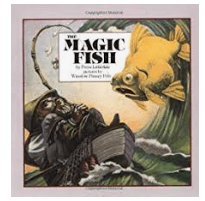
The Magic Fish, Winslow Pinney Pels adapted by Freya Littledale

            A fisherman goes out to sea and catches a magic fish!  The fish brings forth wishes.  What will the man wish for?  Will the wishes make he and his wife happy?

Materials

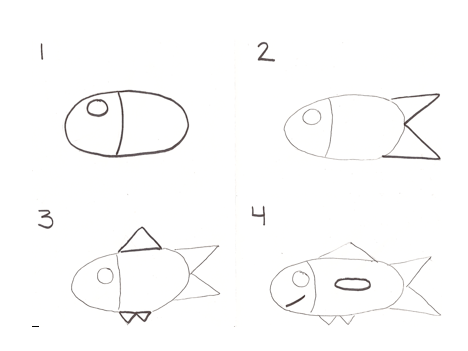
  • How to draw a fish rebus cards
  • Whole fish, keep on ice till ready to use! (See Discovery)

Vocabulary

  • Wish (something that someone really hopes they will get because they really want it)
  • Bossy (Someone who tells other people what to do all the time)
  • Sea ( another name for the ocean)
  • Castle ( a really huge house where a might princess lives)
  • Queen ( the princesses mother and the boss of the land)

Before reading the Story

            Ask the children if they know the word bossy means.  Talk about how lots of people do not like it when someone is always telling them what to do.  Talk about how cooperation is better to help people get along.

Language Development/Speaking & Communicating; develops increasing abilities ti understand and use language to communicate information, experiences, ideas, feelings, opinions, needs, questions; and for other varied purposes.

Reading the Story

            As the fisherman calls to the fish, encourage the children to help you call.  When you speak from the fish, make sure to add some attitude to your voice each time the fisherman comes back and asks for another wish.

Literacy/Book Knowledge & Appreciation; shows growing interest and involvement in listening to and discussing a variety of fiction, non-fiction, and poetry.

After Reading the Story

            Ask the children if they liked the fisherman in the story?  Do you think he was nice? (yes cause he told the fish his wife wanted a castle).  Did you like the wife in the story?  Was she nice? (no cause she was bossy to the man).  Did you like the fish in the story? (no cause he took all the stuff back). Accept all answers.

Literacy/Book Knowledge & Appreciation; shows growing interest and involvement in listening to and discussing a variety of fiction, non-fiction, and poetry. AND Approaches to Learning/Reasoning & problem-Solving; develops increasing abilities to classify, compare, and contrast objects, events, and experiences.

Discovery

If you are so lucky to have a fisherperson in your classroom or life, I love doing this project with children. It really is very cool. I have brought in several small perch to a long gar fish. https://www.youtube.com/watch?v=yga-uaYEWHQ If not, you could ask your director if they could purchase several whole fish from the grocers. When you are finished, talk about the parts of the fish that they see on their finished product.

Science/Scientific Knowledge; expands knowledge of and abilities to observe, describe, and discuss the natural world, materials, living things, and natural processes.

Music and Movement

            Teach the children the action poem Fishy, Fishy.

Fishy, fishy in the brook               Put hands together and make a fish, wiggle back & forth

Daddy catch him with a hook. Pretend to throw line out

Mommy fry you in a pan,             Hold hands palms up and rock back and forth

I can eat you, yes I can.                Pretend to eat fish

Blocks

            Challenge the children you make a boat out of the blocks so we can go fishing. Which blocks will we have to use? How will you make it big enough for the 3 of you?

Mathematics/Geometry & Spatial Sense; progresses in ability to put shapes together and take shapes apart.

Art

            Teach the children how to draw a fish using basic shapes.  Let them draw fish and decorate with crayons or markers. Use the fish drawing cards.

Literacy/Print Awareness; develops growing understanding of different functions of forms of print such as signs, letters, newspapers, lists, messages, and menus. AND Approaches to Learning/Engagement & Persistence; grows in abilities to persist in and complete a variety of tasks, activities, projects, and experiences.

Math & Manipulatives

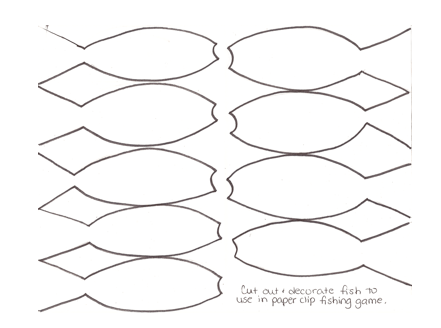
            Cut out fish shapes in several colors of paper.  Write a letter on each side of the fish.  Use letters that are from the childrens names.  Attach a paperclip to each fish.  Attach a magnet to a stick with a piece of yarn.  Let the children fish for letter fish.

Literacy/Alphabet Knowledge; identifies at least 19 letters of the alphabet, especially those in their own name.

Library & Writing

Ask the children to draw a picture of something they wish for. Write their dictation on the bottom of the page. (I wish I could get a puppy. I wish my brother would not hit me).

Literacy/Early Writing; begins to represent stories and experiences through pictures, dictation, and in play.

Sand and Water;

            Water play. Add any small boats or fish that you might have.

Dramatic play

            Bring in pictures, silk flowers, or something different to spruce up the center and make it more beautiful.

Outdoor Play

            Look for long sticks on the playground and attach yarn to one end and we use a pine cone at the other.  The children can then pretend to go fishing. You could also have the children pretend to be fish and then get caught on a fishing pole.

Creative Arts/Dramatic Play; shows growing creativity and imagination in using materials and in assuming different roles in dramatic play situations.

Transitions

            Ask the children to tell something they might wish for as they go off to the next activity.
The Handiest Things in the World, Andrew Clements

                  This book shows pictures of children using their hands for a variety of purposes and then the tools that were invented to do the same job.  This is an interesting book to use during a hand study and a useful book to introduce the concept of tools.

Materials

  • Several sets of chopsticks or unsharpened pencils to make chopsticks. See Dramatic Play.
  • Several calculators, the simpler the better.

Vocabulary

  • Tool (something you use to do work or a job easier)

Before Reading the Story

                  Play Put Your Hands on Your… which is like Simon Says. (Put your hands on your elbows, put your hands on your thighs, etc).

Language Development/Listening & Understanding; shows progress in understanding and following simple and multi-step directions.

Reading the Story

                  As you read the story, make sure to name the different tools on each page.  Give the children the opportunity to discuss the tools as you read.

Language Development/Speaking & Understanding; develops increasing abilities to understand and use language to communicate information, experiences, ideas, feelings, opinions, needs, questions; and for other varied purposes.

After Reading the Story

                  Ask the children if they can think of any other tools that they might use.  Talk about the importance of hands and how we need to take care of them by washing them and not putting them in our mouths.

Approaches to Learning/ Reasoning & problem Solving; develops increasing ability to find more than one solution to a question, task, or problem. AND Health & Development/Health Status & Practices; builds awareness and ability to follow basic health and safety rules.

Discovery

                  Add magnifying glasses and encourage the children to look closely at their hands. (Do you see the little hairs?, watch the creases when you open and close your fingers slowly).  Help them to name the parts of the hands (palm, wrist, flanges, knuckles, cuticles, finger nails, vein under skin).

Language Development/Speaking & Communicating; uses an increasingly complex and varied vocabulary. AND Science/Scientific Knowledge; expands knowledge and respect for their bodies and the environment.

Music and Movement

                  Let the children experiment with instruments today.

Creative Arts/Music; experiments with a variety of musical instruments.

Do The Hand Chant.  Have the children do the actions to accompany words.

Wiggle them, wiggle them, wiggle them so.

Wiggle them high, wiggle them low.

Wiggle them fast and wiggle them slow.

Wiggle them wiggle them out of sight.

(Clap them, roll them shake them, snap them)

Language Development/Listening & Understanding; shows progress in understanding and following simple and multiple-step directions. AND Approaches to Learning/Initiative & Curiosity; chooses to participate in an increasing variety of tasks and activities.

Blocks

                  Add several rulers to the center today.  As the children build, show them how to measure how tall or how long their structure is.

Mathematics/Patterns & Measurement; shows progress in using standard and non-standard measures for length and area of objects.

Art

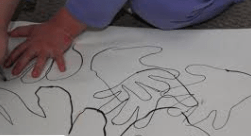
                  Trace around the childrens hands onto a piece of paper using a black marker. Trace their hands several times so that the hands overlap. Let the children use colored markers to fill in the spaces made by overlapping their hands.  For older children, encourage them to trace around their friends hand.

Literacy/Early Writing; experiments with a growing variety of writing tools and materials, such as pencils, crayons, and computers.

Sand and Water

                  Put out water today and containers to hold it and pour it.

Social & Emotional Development/Self-Control; demonstrates increasing capacity to follow rules and routines and use materials purposefully, safely, and respectfully.

Library and Writing

                  Use crayons, markers, and colored pencils to practice writing names today.

Literacy/Early Writing; experiments with a growing variety of writing tools and materials, such as pencils, crayons, and computers. AND Literacy/Early Writing; progresses from using scribbles, shapes, or pictures to represent ideas, to using letter-like symbols, to copying or writing familiar words such as their own name.

Dramatic Play

                  Add some chopsticks to the center.  Try rubber banding the tops about an inch down to make it easier for the children to manipulate. ENcourage the children to try to pick up plastic foods and small items.

Physical Health & Development/Fine Motor Skills; develops strength, dexterity, and control needed to use tools such as scissors, paper punch, stapler, and hammer.

Math and Manipulatives

                  Add calculators today and show the children how to punch in different numbers.  Can they punch in the numbers as you recite their phone number?  Can they name the different numbers correctly?

Mathematics/Numbers & Operation; begins to associate number concepts, vocabulary, quantities, and written numerals in meaningful ways. AND Physical Health & Development/Fine Motor Skills; grows in hand-eye coordination.

Outdoors Play

Put out lots of shovels for digging in the sandbox and also dirt. Give the children rakes to pull the dirt away from the hole. Talk about how shovels and rakes are handy tools. Talk about how by cooperating together the children can dig a really big hole.

Social & Emotional Development/Cooperation; increases abilities to sustain interactions with peers by helping, sharing , and discussion.

Transitions

                  Have the children take turns picking a tool card and then see if they can act it out or tell it’s purpose.

The Gingerbread Boy, by Paul Galdone

           A little old lady and a little old man always wanted a child.  One day the woman decides to bake a gingerbread boy.  The gingerbread boy has his own ideas and runs away.  Join in the chase with a delicious ending, at least for the fox.

Materials

            Sequins or small buttons

            Animal Crackers.

            Recopy poem and add animals

            Person shaped cookie cutter

            2 gingerbread boys to be used to measure

Vocabulary

  • Threshing (using the stick to separate the seeds from the stalk of the wheat)

Before Reading the Story

Hold up the cover of the book and read the title. Ask the children if they have ever seen a boy that looked like this? Can they guess what he is made of? Ask the children if they have ever heard a similar story (The GingerBread Man, The GingerBread Woman). If so, ask them if they can recall what happened in the story.

Language Development/Speaking & Communicating; progresses in abilities to initiate and respond appropriately in conversation and discussions with peers and adults.

Reading the Story

            When the gingerbread boy gets up and runs, ask the children why they think he would do that?  After each character/s begin to chase the gingerbread boy ask them if they think he will get caught.  When the gingerbread boy gets up on the foxes nose, ask the children what they think is going to happen.

Literacy/Book Knowledge & Appreciation; demonstrates progress in a bilities to retell and dictate stories from book sans experiences; to act out stories in dramatic play; and to predict what will happen next in a story.

After Reading the Story

            Ask the children if they think the fox should have eaten the gingerbread boy, why or why not.  If you caught the gingerbread boy what would you do? Play What Would You Do with the children. Ask questions that ask the children to make judgement calls. What would you do if you were walking down the street and you found a cookie just lying on the ground? WOuld you eat it? What would you do if you were helping your neighbor sweep her sidewalk and she gave you a cookie when you were finished, would you eat it? What would you do if you were cleaning your room and you were looking under your bed and you saw a cookie, would you eat it? What would you do if I gave you a cookie and then your friend came over but did not get one? What would you do if you saw your cat playing with something and you went to see what and it was a cookie? Talk with the children about when it is safe to eat something and when it is not

Physical Health & Development/Health Status & Practices; builds awareness and ability to follow basic health and safety rules such as fire safety, traffic and pedestrian safety, and responding appropriately to potentially harmful objects, substances, and activities.

Discovery

           Give each child several animal crackers/cookies. What shapes do you have? What color are they? What do they smell like? Are they hrd or soft when you bite? Does it make a sound when you bite it? Do you like the taste? Is it sweet or sour? Graph which children like animal crackers and those who do not.

Science/Scientific Methods & Skills; develops growing abilities to collect, describe, and record information through a variety of means, including discussion, drawings, maps, and charts.

Music and Movement

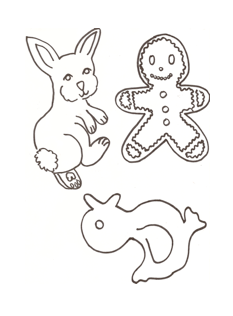
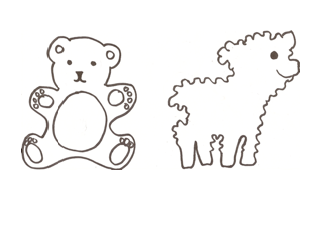
Cut out the pieces for the Runaway Cookies poem and present it to the children. Do a second time and let the children come and take the appropriate cookie off the board and act out it’s actions.

The cookie jar people hopped out one night, when the cookie jar lid was not on tight.

The gingerbread man opened his raisin eyes and looked about in a great surprise.

The frosted bunny twinkled his nose and dance around on his cookie toes.

The sugary duck began to quack and shook the sugar right off his back.

The cinnamon bear could only grunt, he was too fat to do a stunt.

The coconut lamb jumped so high, that her little tail nearly touched the sky.

The cookies were happy to be at play so they never went back to the cookie jar that day.

Language Development/Listening * Understanding;demonstrates increasing ability to attend to and understand conversations, stories, songs, and poems.

Blocks

            Line up 5 animals or people on the floor.  Ask the child which is first in line, last, which is in the middle, which is second.  Have the child name the animals or people (fireman, doctor, teacher, policeman, construction worker).

Mathematics/Number & Operations; begins to associate concepts, vocabulary, quantities, and written numerals in meaningful ways.

Art

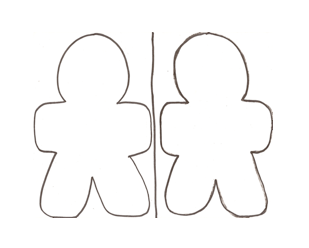
            Have the children roll out play dough and make gingerbread people.  Use the sequins or buttons to adorn them.

Creative Arts/Art; gains ability in using different art media and materials in a variety of ways for creative self expression and representation.

Sand and Water

            Water play today.

Social & Emotional Development/Self-Control;demonstrates increasing capacity to follow rules and routines and use materials purposefully, respectfully, and safely.

Library and Writing

            Copy the gingerbread boy shape onto several manila files and cut out.  Let the children trace around them and cut them out.  Let them color them if they choose to.  Ask the children to pretend that the cookie becomes a real person, what would you name it, and what might you say to it?  Write their responses on the back.

Physical Health & Development/Fine Motor Skills; develops growing strength, dexterity, and control needed to use tools such as scissors, paper punch, stapler, and hammer. AND Literacy/Early Writing; begins to represent stories and experiences through pictures, dictation, and in play.

Math and Manipulatives

            Cut out the gingerbread cookies and let the children use them to measure strips of tape on the floor and objects around the room (the table is 8 gingerbread boys and 1 head long)

Mathematics/Patterns & Measurement; Shows progress in using standard and non-standard measure for length and area of objects.

Outdoor Play

            Have the children line up in a line and run around the playground staying in the line.  They can pretend to be the characters in the story.  Teacher is first and calls out “Run, run as fast as you can, you can’t catch me I’m the gingerbread boy!”

Physical Health & Development/Health Status & Practices; participates actively in games, outdoor play, and other forms of exercise that enhance physical fitness.

Transitions

Hand out the five cookie shapes from music to five children. Repeat the Runaway Cookie poem. When the child’s cookie type is called, they may transition to the next activity. Give to five more and continue until all the children have been called to transition.

Language Development/Listening & Understanding; shows progress in understanding and following simple and multi-step directions.

Resources