Little Cloud, by Eric Carle

            This is a good introduction for children to clouds.  It is fun and shows through simple words and pictures how a cloud becomes a rain storm.

Materials;

File folder with a 1-inch hole cut in it.

Interesting pictures for the children to guess

Scarf per child or 2-foot strip of crepe paper

Cookie tray

 Eye droppers

  Baby powder

  Ivory snow flakes

Plastic containers with holes punched through the bottom.

Cotton Balls

Vocabulary

Before Reading the Story

Hold the file folder with the hole cut in it, up so the children can all see. Behind it put an interesting picture that the children will try to guess by looking at the hole. Move the picture around so that they can only see a small portion at a time.

Initiative & Curiosity; chooses to participate in an increasing variety of tasks and activities.

Reading the Story

            Hesitate on each page long enough to see if the children can guess what Little Cloud turns into next.

Literacy/Book Knowledge & Appreciation; shows interest and involvement in listening to and discussing a variety of fiction and non-fiction, and poetry.

After Reading the Story

            Give each child a scarf or a 2 foot piece of crepe paper.  Put on some slow music and have the children cloud dance.  As they dance, ask them what they imagine themselves to be.  In the end have all the children come together and become a rain cloud.

Creative Art/Dramatic Play; shows growing creativity and imagination in using materials and in assuming different roles in dramatic play situations.
Discovery

            Place the cookie tray on the table so that it is propped up at one end, to be on an angle.  Gently shake some baby powder on top of the cookie tray.  Show the children how to fill an eyedropper up with water and drip the water onto the top end of the angled cookie sheet.  The water will drip down the sheet.  As the children continue to do this, the drops will begin to come together. Talk about how drops come together to form a big cloud. Have the children tell you what they see happening.

Science/Scientific Skills & Methods; develops growing abilities to collect, describe, and record information through a variety of means, including discussion, drawings, maps, and charts.

Music and Movement

            Sung to 1 little 2 little, 3 little Indians.

1 little 2 little 3 little clouds

4 little 5 little 6 little clouds

7 little 8 little 9 little clouds

10 little clouds float by.

(hold up fingers accordingly.  Now go from 10 to 1)

Mathematics/Number & operations; develops increasing ability to count to 10 and beyond.

            In to the tune of Pop Goes the Weasel. https://www.youtube.com/watch?v=y45-G61kuqg

All around the sky today,

The clouds are full of raindrops.

They push and shove until they burst,

Out pop the raindrops.

Science/Scientific Knowledge; shows increased awareness and beginning understanding of changes in materials and cause-effect relationships.

            Tell the children that you are going to do a cloud dance.  Put on music and have the children spread out around the room.  Let them whirl and swirl and float like clouds.  Have them begin to gently bump into each other and then form groups getting bigger and bigger until all of the children are one very large cloud.  Count to three and all clap your hands (this is the thunder) and then fall to the ground in a rainstorm.

Science/Scientific Knowledge; shows increased awareness and beginning understanding of changes in materials and cause-effect relationships.

            You could also do this activity by singing, One Fluffy Cloud, to One Elephant. https://www.youtube.com/watch?v=Tf68lVnvR6E

One fluffy could a way up high

Danced and swirled in the clear blue sky.

He had so much fun that day

That he called for another cloud to come and play.

Mathematics/Number & operations; develops increasing ability to count to 10 and beyond.

Blocks

Art

            Make textural clouds.  In a bowl pour the ivory snowflakes and then begin adding water.  Use a fork or spoon to mix them into a whipped texture.  Depending on how thick you make these, the children can sculpt a cloud shape onto a piece of cardboard or they can paint with a stiff brush onto a piece of cardboard. 

Creative Arts/Art; gains ability in using different art media and materials in a variety of ways for creative expression and representation.

Library and Writing

            Have the children fold a piece of blue paper in half and then open back up.  Pour a spoonful of white paint onto one half of the paper so that it touches the crease line.  Fold it back up and show the children how to use the heel of their hand to spread the paint.  Open the paper back up.  Ask the children to look the design and say what it looks like to them.  One the bottom of the paper write; Small Cloud changed into a _________. This could easily be made into a class book.

Literacy/Early Writing; begins to represent stories and experiences through pictures, dictation, and in play.

Sand and Water

            Put out a variety of containers that allow water to fall through them at various rates.  These can easily be made by poking holes in the bottom of plastic containers.  As the children let the water pour through the holes, it will sound like rain.

Science/Scientific Skills & Methods; develops increasing ability to observe and discuss common properties, differences and comparisons among objects and materials.

 Dramatic Play

            Add any rain gear that you have; umbrellas, boots, slickers.

Creative Arts/Dramatic PLay; participates in a variety of dramatic play activities that become more extended and complex.

Math and Manipulatives

On pieces of blue paper write the numbers 1-5 or 1-10. Ask the children to put the correct amount of cotton balls onto each piece of paper by ‘reading’ the number and counting out the cotton balls. For children who are just learning to identify number shapes, make corresponding dots also. For children who are versed in numbers, write the letter name as well as the shape onto the paper.

Mathematics/Number & Operations; begins to use one-to-one correspondence in counting objects and matching groups of objects.

Outdoor Play

            Take a blanket or old sheet outside and lay on the ground and watch the clouds float by.  Bring clip boards and paper so the children can draw the clouds as they look.

Science/Scientific Skills & Methods; develops growing abilities to collect, describe, and record information through a variety of means, including discussion, drawings, maps, and charts.

Transitions

            As the children move to the next activity, have them turn into objects and go.  Kerry turn into an elephant with a long trunk, Roger turned into a kangaroo and bounce.

Creative Arts/Dramatic PLay; shows growing creativity and imagination in using materials and in assuming different roles in dramatic play situations.
Hats Off To Hair! by Virginia Kroll

            So many ways people wear their hair.  This book shows pictures of children wearing real hairstyles.  Children will be able to identify with some of the do’s and be able to better appreciate the diversity and beauty that sits on top of our heads.

Materials

  • Face picture for art
  • You can make pigtails ahead of time from thick yarn that has then been glued to a headband.  This can be put into the dramatic center along with the hair boutique prop box.
  • Several unbreakable mirrors
  • Several plastic combs

Vocabulary

  • Style (how you wear your hair or the way your hair is cut)
  • Texture (how your hair feels)
  • Blonde (light colored hair)

Before Reading the Story

Put a piece of masking tape down the cente of your circle time area. Tell the children that you are going to play a listening game. Say; If you have very short hair stand over here and everyone else stand over there. If you have hair past your shoulders statand over here, if not stand over there. If you have curls, straight hair, bangs, beads in your hair, barretts or pony tail holders, if your ears are covered by your hair, etc..

Language Development/Listening & Understanding; shows progress in understanding simple and multiple-step directions.

Reading the Story

            As you read, if any child’s hair reminds you of a picture in the book, be sure to show the children and say the name of the hair type (Kerry you have waves like Samoa!)

Social & Emotional Development/Self-Concept; begins to develop and express awareness of self in terms of specific abilities, characteristics, or preferences.

After Reading the Story

Ask the children if they can think of anyways that people help keep their hair clean and looking nice. (I wash mine with Batman shampoo. My Mom combs mine and it hurts my head! I wear braids with beads. I got a haircut last week). Continue talking about regular hygiene if the children are still interested in sharing (importance of toothbrushing, bathing, cleaning hands, etc).

Physical Health & Development/Health Status & Practices; builds awareness and ability to follow basic health and safety rules such as fire safety, traffic and pedestrian safety, and responding appropriately to potentially harmful objects, substances, and activities. AND Science Knowledge; expands knowledge of and respect for their bodies and the environment.

Discovery

            The story talks about the different textures of hair. Either bring in objects or use objects from the room that the children can feel to experience the textures of; smooth, bumpy, fuzzy, curly, knotted, and twisted.  Let the children sort and touch a variety of textured items. 

Science/Scientific Skills & Methods; develops increased ability to observe and discuss common properties, differences and comparisons among objects and materials.

            If you have access to a microscope, pull a hair out of your head to be examined.

Science/Scientific Skills & methods; begins to use senses and a variety of tools and simple measuring devices to gather information, investigate materials, and observe processes and relationships.

Music and Movement

            Sing This is the Way… https://www.youtube.com/watch?v=4XLQpRI_wOQ

  This is the way I brush my hair, brush my hair, brush my hair

 This is the way I brush my hair, each and every day.

This is the way I shampoo my hair, this is the way I dry my hair, this is the way I put barrettes in my hair,. Act out different motions as you sing.

Social & Emotional Development/Self-Concept; begins to develop and express awareness of self in terms of specific abilities, characteristics, or preferences.

Blocks

Art

            Give each child a copy of a blank head.  Have the children color a face and hair. They can then use the scissors to cut strips into the hair and curl around a pencil if they like.

Physical Health & Development/Fine Motor Skills; progresses in abilities to use writing, drawing, and art tools, including pencils, markers, chalk, paint brush, and various types of technology.

            Add a large head shape to the easel and encourage the children to paint a self portrait.  Put a mirror beside the easel so they can look at themselves while they paint.

Social & Emotional Development/Self-Concept; begins to develop and express awareness of self in terms of specific abilities, characteristics, or preferences.

Library and Writing;

            Put out a mirror so the children can look at their own hair.  Add the book to the center so the children can compare their hair to that in the story.

Mathematics/Patterns & measurement; begins to make comparisons between several objects based on a single attribute.

Make a copy of The Hair Book for each child in the room. you can help the children work on this at school or you could send it home as a Parent-Child Activity. https://www.teachingbooks.net/tb.cgi?tid=2960 Thank you to Teaching Tolerance web site.

Sand and Water

            Put several combs in to the table along with a small amount of dried sand.  The children can use the combs to draw patterns in the sand.

Creative Arts/Art; gains ability in using different art media and materials in a variety of ways for creative expression and representation.

Dramatic Play

            Put out a beauty parlor prop box.  Add curlers, plenty of combs, barrettes, empty bottles of shampoo, hair pieces/wigs, and  dolls with hair.  Remind the children that they may NOT cut their hair or any other child’s.

Social & Emotional Development/Knowledge of Families & Communities; develops growing awareness of jobs and what is required to perform them.

Math and Manipulatives

            Hair comes in many lengths.  Some people have long hair and some people have short hair.  Help the children take a piece of yarn and holding it at the crown of their head, measure it to the length of the child’s hair and cut it (the yarn).  Challenge the child to find something in the room that is as long as their hair.  Tape the yarn “hair lengths” to the wall from shortest to longest.

Mathematics/Patterns & Measurement; shows progress in using standard and non-standard measures for length and area of objects.

Outdoor Play

Have the children stand quietly on the playground and close their eyes. Can they feel the wind moving their hair?

Science/Scientific Skills & Methods; begins to use senses and a variety of tools and simple measuring devices to gather information, investigate materials, and observe processes and relationships.

Transitions

            Make a graph that shows; Colors of our hair.  At the bottom write blonde, brown, black, red, other.  Have the children put on their mark as they head to the next activity.  Later compare which hair color has the most and least children in it.

Social & Emotional Development/Self-Concept; begins to develop and express awareness of self in terms of specific abilities, characteristics, or preferences. AND Mathematics/Number & Operations; begins to use language to compare numbers of objects with terms such as more, less greater than, fewer, and equal to.

Resources

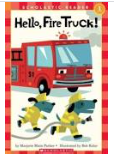
Hello, Fire Truck! by Marjorie Blain Parker

            Very simple book about firemen.  This is a beginner reader so perhaps older children can learn to sound out a read.

Materials

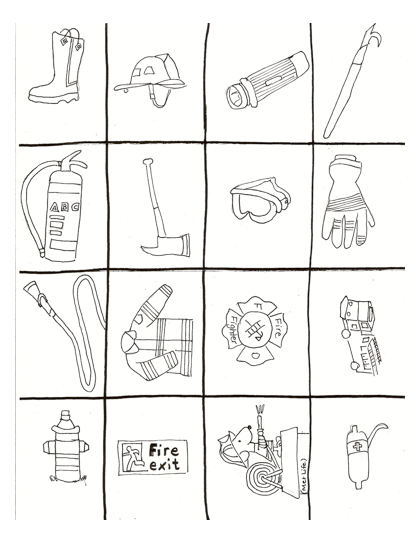
  • Pictures of fireman’s gear
  • Page with words to copy 911
  • Smoke detector
  • Spray bottle with water

Vocabulary

  • Gear (all the equipment firemen need to put out a fire)

Before Reading the Story

            Color and contact the fireman’s gear pictures.  Bring to the rug and tape them to a flannel board.  Ask the children if they can tell who the story is going to be about by looking at the special equipment that is needed.  State it is about firemen.  Ask the children to help you name all the gear/equipment.  Turn the board around and remove one item, let the children guess what piece of gear is missing.  Play until each item has been removed at least once.

Social & Emotional Development/Knowledge of Families & Communities; develops growing awareness of jobs and what is required to perform them.

Reading the Story

            This book is very simple and full of rhymes on every other page.  Read the first page and then when you get to its rhyming word segment it out.  For example; “Look-smoke and flames.  Kitty is in trouble.  Call 911! Quick-on the d/ou/ble”. Do this slowly to see if any children can hear and discriminate the final word.

Literacy/Phonological Awareness; shows growing ability to hear and discriminate separate syllables in words.

After Reading the Story

            Bring in a smoke detector for the children to see up close and experience the sound of the alarm.  Talk about what you should do in case the smoke detector goes off at school. Do a mock drill if allowed.

Physical Health & Development/Health Status & Practices; builds awareness and ability to follow basic health and safety rules such as fire safety and pedestrian safety, and responding appropriately to potentially harmful objects, substances,and activities.

Discovery

            Put play phones into the center and help the children practice dialing 911, stating their name and what the emergency is.

Mathematics/Number & Operations; begins to associate number concepts, vocabulary, quantities, and written numbers in meaningful ways. AND Language Development/Speaking & Communicating; progresses in clarity of pronunciation and towards speaking in sentences of increasing length and grammatical complexity.

Music and Movement

            Teach the children The Fireman poem.

I am the fireman.

Please check your smoke detector

Because they are your home protector

I am the fireman.

Language Development/Listening & Understanding; understands an increasingly complex and varied vocabulary.

            Use masking tape to make a ladder design on the floor.  Put on music and encourage the children to jump between the rungs, walk heel to toe up the side, walk with one foot on each side bar. 

Creative Arts/Music; participates with increasing interest and enjoyment in a variety of music activities, including listening, singing, finger plays, games, and performances. AND Physical Health & development/Gross Motor Skills; shows increasing levels of proficiency, control, and balance in walking, climbing, running, jumping, hopping, skipping, and galloping.

Blocks

            Add fire trucks and encourage the children to build houses with blocks.

Creative Arts/Dramatic Play; participates in a variety of dramatic play activities that become more extended and complex.

Art

            Have the children draw a picture of a house using water soluble magic markers.  Find a place where you can hang the house pictures up and give each child a spray bottle of water.  They then spray the house pretending to put out the fire.  The markers will run down the page and make a design.

Creative Arts/Art; develops growing abilities to plan, work independently, and demonstrate care and persistence in a variety of art projects.

Library and Writing

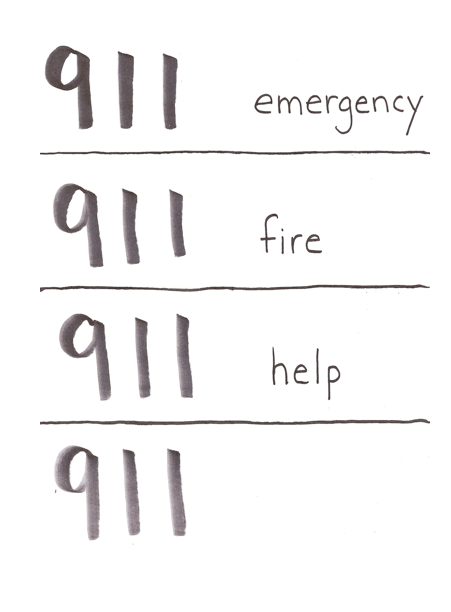
            Put out cards that have the numbers 911 written on it.  Encourage the children to copy the numbers. 

Literacy/Early Writing; experiments with a growing variety of writing tools and materials, such as pencils, crayons, and computers. AND Mathematics/Number & Operations; begins to associate number concepts, vocabulary, quantities, and written numerals in meaningful ways.

Sand and Water

Have the children bring their picture from the art center and spray it in the water table today.

Physical Health & Development/Fine Motor Skills; develops growing strength, dexterity, and control needed to use tools such as scissors, paper punch, stapler, and hammer.

Dramatic Play

            Bring in fireman props you may have (3 foot piece of hose, boots, jackets, and plastic helmets. Talk about how the firefighter must put on all the gear before he/she heads out to a fire.

Social & Emotional Development/Knowledge of Families & Communities; develops growing awareness of jobs and what is required to perform them.

Math and Manipulatives

Make two sets of the firefighter gear pages and cut out the pictures to make a memory game to play with the children.

Approaches to Learning/Engagement & Persistence; grows in abilities to persist and complete a variety of tasks, activities, projects, and experiences.

Outdoor Play

            Use bicycles or wagons and pretend that they are fire engines racing to the fire.  Make sure the children are making loud siren noises so that everyone else will move out of the way!

Creative Arts/Drama; shows growing creativity and imagination in using materials and in assuming different roles in dramatic play activities. AND Physical Health & Development/Health Status & Practices; participates actively in games, outdoor play, and other forms of exercise that enhance physical fitness.

Transitions

            Give each child a turn to practice dialing 911 and stating who they are and that there is a fire.  Send a note home today that encourages parents to practice their address and phone number with the children so that they can call for help in an emergency.

Physical Health & Development/Health Status & Practices; builds awareness and ability to follow basic health and safety rules such as fire safety and pedestrian safety, and responding appropriately to potentially harmful objects, substances,and activities.

Resources