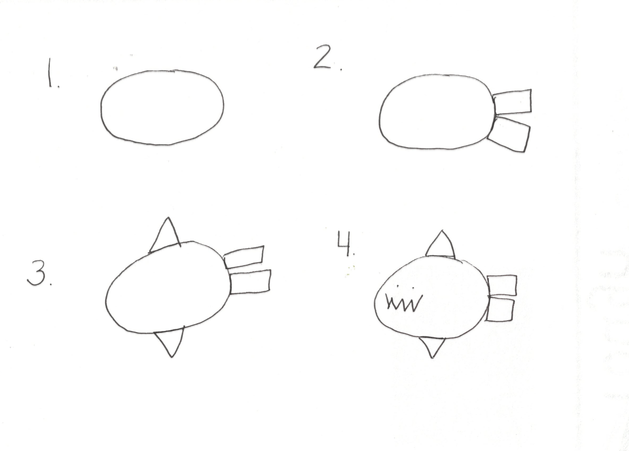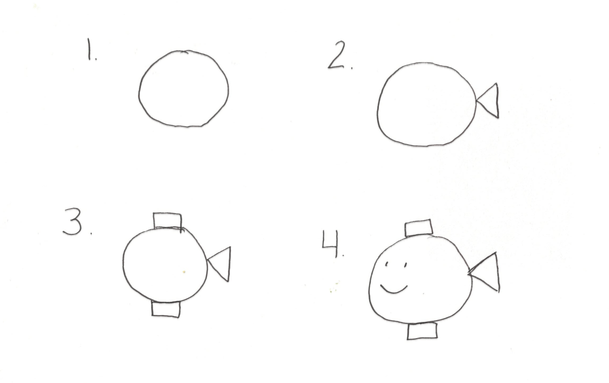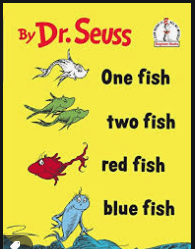
One fish Two fish Red fish Blue fish, by Dr. Seuss

            This is a classic silly Dr. Suess book that children enjoy.  It introduces opposites as well as rhyming words in the traditional Dr. Seuss style.  Enjoy, the children will.

Materials

Directions for drawing fish

Vocabulary

Before reading the Story

            As you introduce the book, show the children the cover.  Point to the word fish on the cover and tell them that this says fish.  Ask them if they can read the cover of the book.  Point to the one fish and say, One ____.  Point to the 2 fish and see if  they can figure out what it says.  Point to the red fish and sound out the word r-e-d _____.  Now point to the blue fish and begin to sound out until children figure out.  Repeat this on the cover page of the book.

Literacy/Phonological Awareness; associates sounds with written words, such as awareness that different words begin with the same sound.

Reading the Story

            As you read the story, point to the objects so the children can try to guess/read along and say the rhyming words. 

Literacy/Phonological Awareness; progresses in recognizing matching sounds and rhymes in familiar words, games, songs, stories, and poems.
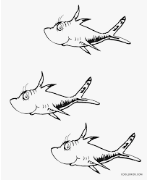
On page 12 it talks about the number of feet the animals have.  Ask the children how many feet they/people have?  On page 17 the man has 11 fingers.  Ask the children how many fingers people have?

Mathematics/Number & Operations; begins to make use of one-to-one correspondence in counting objects and matching groups of objects.

After Reading the Story

            Write ‘ish’ on the top of a large piece of paper.  Tell the children that this says ish.  Can they think of any words that rhyme with ish?  If they can not, write d ish.  Make the /D/ sound + ish.  Dish!  It rhymes.  Try another.  Allow the children to use made-up words such as bish, lish, etc.. the idea is to encourage the children to think up words that rhyme. When you have run out of ish words do at words or og.

Literacy/Phonological Awareness; progresses in recognizing matching sounds and rhymes in familiar words, games, songs, stories, and poems

Discovery

Introduce the opposites of Rough and Smooth. Use two pieces of paper and at the top of one write Rough and draw a picture of a bumpy line. On the top of the other piece of paper, write Smooth and draw a straight line. Collect a basket of objects from your room that are either rough or smooth and let the children sort accordingly. As the work, encourage them to feel the surface. Can they think of any other objects that are rough or smooth? (plastic food, a block, a crayon, a piece of sandpaper, fabrics from your collage materials, types of papers such as waxed or foil that is both flat and has ben crumpled and then smoothed, lego, etc).

Science/Scientific Methods & Skills; develops growing abilities to collect, describe, and record information through a variety of means, including discussion, drawings, maps, and charts.

Music and Movement

            Sing Rhyming Words Sound the same, to the chorus of the Mexican Hat Dance. https://www.youtube.com/watch?v=QK4QWrecm8g

Rhyming words sound the same (clap, clap)

Rhyming words sound the same (clap, clap)

Rhyming words sound the same (clap, clap)

Rhyming words sound the same.

Name a word from the book and see if children can make a rhyme

Literacy/Phonological Awareness; progresses in recognizing matching sounds and rhymes in familiar words, games, songs, stories, and poems

For something different, you could play One Fish, Two Fish in rap for the children to dance to. https://www.youtube.com/watch?v=evQhWcZ-gbU

Teach the children the song 1,2,3,4,5 I Caught a Fish Alive. https://www.youtube.com/watch?v=evQhWcZ-gbU.

Mathematics/Number & Operations; develops increasing ability to count to 10 in sequence and beyond.

Blocks

Encourage the children to make patterns with their blocks today. (Red block, blue block, red block, blue block. Square block, rectangle block). For older childre children you could try encouraging an ABB pattern or an ABC pattern. For children who are new to patterns, try drawing it on paper for the children to follow using the blocks.

Mathematics/Patterns & Measurement; enhances abilities to recognize, duplicate, and extend simple patterns using a variety of materials. AND Physical Health & Development/Fine Motor Skills; grows in hand-eye coordination in building with blocks, putting together puzzles, reproducing shapes and patterns, stringing beads, and using scissors.

Art

Put out simple drawing directions for making fish. Hang the children’s fish on the wall titled, “Here to There, Funny Fish are Everywhere”.

Literacy/Print Awareness & Concepts; develops a growing understanding of different functions of forms of print such as signs, letters, newspapers, lists, messages, and menus.

Library and Writing

            Tell the children that fish begins with the letter /F/.  Make a list of /F/ words.  The children could then illustrate the words and put them on the word wall.

Literacy/Phonological Awareness; associates sounds with written words, such as awareness that different words begin with the same sound.

Sand and water

            Water in the table today.

Social & Emotional Development/Self-Control; demonstrates increasing capacity to follow rules and routines and use materials purposefully, safely, and respectfully.

With older preschoolers I have put live goldfish into the water table for the day. I use the day to clean the aquarium and it gives the children the opportunity to examine the fish from above and to gently touch the fish. We had a goldfish one year that truly seemed to enjoy being ‘pet’. This is an activity that you will have to carefully monitor and also discuss ahead of time. It is also one that the children really enjoyed.

Social & Emotional Development/Self-Control; demonstrates increasing capacity to follow rules and routines and use materials purposefully, safely, and respectfully. AND Science/Science Knowledge; expands knowledge of and abilities to observe, describe, and discuss the natural world, materials, living things, and natural processes.

Dramatic Play

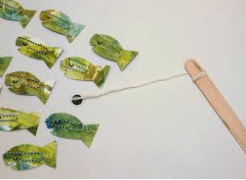
Bring several chairs into the center to make a pretend ‘boat’. The children can pretend to fish using rods made from dowel rods, rulers, or paper towel tubes. To extend, make fish and color different colors or add letters to their bodies. Put a paperclip on each fish and a magnet attached to the rod by a piece of yarn about 12-18 inches long.

Physical Health & Development/Fine Motor Skills; grows in hand-eye coordination in building with blocks, putting together puzzles, reproducing shapes and patterns, stringing beads, and using scissors.

Math and Manipulatives

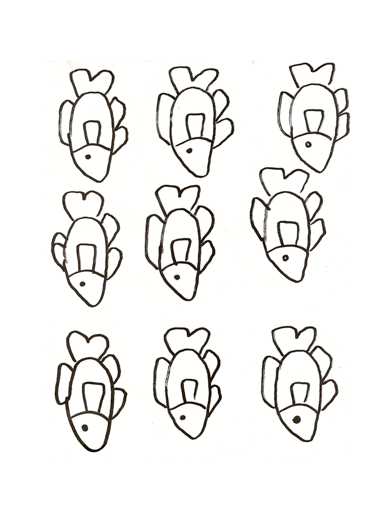
            Use the fish pattern and make a page of red, yellow, blue, and green fish.  Cut them out and use with the children to make patterns.  Can you make a pattern just like this?  Kerry made a pattern, let’s all see if we can copy hers.

Mathematics/Patterns & Measurement; enhances abilities to recognize, duplicate, and extend simple patterns using a variety of materials.

Outdoor play

            The story talks about creatures from here to there.  Think of silly ways to move across the playground from here to there and there to here.  Silly children everywhere!

Physical Health & Development/Gross Motor Skills; shows increasing levels of proficiency, control, and balance in walking, climbing, running, jumping, hopping, skipping, marching, and galloping.

Transitions

            Using the book, turn to a page and give the child a word from the story and see to if he/she can make a rhyming word to go with it.

Literacy/Phonological Awareness; progresses in recognizing matching sounds and rhymes in familiar words, games, songs, stories, and poems.
Cut out fish drawing directions and glue to a piece of paper starting left and moving to right so children “read” the directions in order to draw a fish.

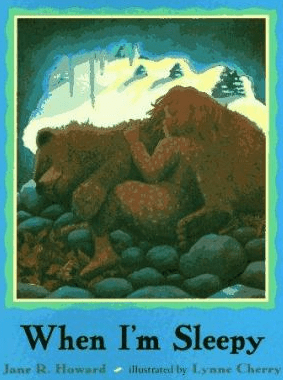
When I’m Sleepy, by J.R. Howard

            This story has lovely illustrations of a little girl asleep with a variety of animals.  It is a fun book to re-read before nap time and to talk about how wonderful a nice bed is for sleep.

Materials

            Animal BINGO game

Bear flannel pieces

4-5 stuffed animals or rubber animals

Vocabulary

Before Reading the Story

            Ask the children if they know why a good nights sleep is important (When we sleep our bodies grow.  Our bodies need the night sleep to rest up and get ready for a busy day.  We think better when we are not sleepy).  Tell the children everybody needs to sleep, children, parents, and even animals.

Physical Health & Development/Health Status & Practices; builds awareness and ability to follow basic health and safety rules such as fire safety, traffic and pedestrian safety, and responding appropriately to potentially harmful objects, substances, and activities.

  Ask the children if anyone has a pet dog at home.  Have you ever watched it sleep?  How can you tell it is asleep?   Tell the children that you are going to pretend that you are sleeping dogs.  Have the children lie on their sides and relax their bodies.  Ask them to pretend that they are dreaming about running in the back yard and begin to move their arms and legs like they are running.  Tell them to lay very still now and think about how a mother bird might sleep.  Let the children respond and then say birds often sleep standing on a branch.  Ask the children to stand and pretend to curl their toes around a branch.  Have them bend their knees slightly and tilt their head forward until their chin is touching their chest.  Do you think sleeping like a bird would be easy?  Have the children sit down.  Ask them if they have ever seen a fish in the fish tank that looks like it is just sitting there and not moving?  That’s when the fish is asleep.  Have the children put their hands on their waist and push their elbows backwards then move them slightly in and out. 

Creative Arts/Dramatic Play; participates in a variety of dramatic play activities that become more extended and complex.

Tell the children that all living creatures need to sleep in order to grow big and strong.  Say that people are lucky because we get to sleep on nice comfortable beds.  Ask them if they sleep with anything that makes their bed especially comfortable (blanket, pillow, stuffed animal, sister, soft pajamas).

Social & Emotional Development/Self-Concept; begins to develop and express awareness of self in terms of specific abilities, characteristics, and preferences.

Reading the Story;

            As you read the story, have the children name the animals on each page. 

Literacy/Book Knowledge & Appreciation; shows growing involvement in listening to and discussing a variety of fiction and non-fiction books and poetry.

After Reading the Story

            Ask the children to recall the animals of the story.  Do you remember how or where they were sleeping?  Do a quick review of why we need a good night’s sleep.  Tell them that babies need the most sleep and adults need the least.  But children need lots of sleep because your bodies are growing bigger and getting stronger every single day. Let the children talk about their bedtime rituals and sleeping habits.

Approaches to Learning/Initiative & Curiosity; grows in eagerness to learn about and discuss a growing range of topics, ideas, and tasks.

Discovery

            Make a height chart of your children.  If you already have a height chart, revisit it and up-date children’s heights.  Note how big they have grown.  On the bottom of the height chart mark 20 inches.  Tell the children this is about how tall they were when they were born. As you mark each child, help them see where their measurement stands in relation to the rest of the children. (Look Anna, you are the same height as Lisa, Look Anna, this is where you were when we measured you last and you have grown all the way to here!).

Mathematics/Patterns & Measurement; shows progress in using standard and non-standard measures of length and area.

Music and Movement

Teach the children the poem, You Have to Eat Good Food by F Koch.

You have to eat good food to grow, grow, grow

You have to exercise to grow, grow, grow

You have to sleep at night to grow, grow, grow

Take good care of yourself. 

Give yourself a giant hug, because you deserve it!

Physical Health & Development/Health Status & Practices; builds awareness and ability to follow basic health and safety rules such as fire safety, traffic and pedestrian safety, and responding appropriately to potentially harmful objects, substances, and activities.

Sing 5 Bears In the Bed. https://www.youtube.com/watch?v=wv4Utm-OJK8 Or teach it is Spanish! https://www.youtube.com/watch?v=nB0JlJB-DYE Use fingers to designate the bears, or make flannel bears that you can use. Write a number 1-5 on each bear.

Mathematics/Number & Operations; begins to associate number concepts, vocabulary, quantities, and written numerals in meaningful ways.


Blocks

            Ask the children if they can make beds for the stuffed animals.

Mathematics/Patterns & Measurement; shows progress in using standard and non-standard measures of length and area. AND Approaches to Learning/Engagement & Persistence; demonstrates increasing ability to set goals and develop[ and follow through on plans.

Art

            Make laced up pillows.  Punch holes around pieces of 5×7 construction paper.  The holes should be one inch apart.  Let each child take two pieces of construction paper and hold them together.  Give each child a piece of yarn with masking tape wrapped around one end and show them how to lace it in and out of the holes.  After they have laced three sides, let them stuff it with pieces of squished paper towel and finish lacing.

Physical Health & Development/Fine Motor Skills; grows in hand-eye coordination in building with blocks, putting together puzzles, reproducing shapes, and patterns, stringing beads, and using scissors.

            Put plastic fish in to the water table.  The children can pretend to make them swim around and then let them sleep. Add a net for catching and counting fish. If you do not have plastic fish, ask the children if they can think of a manipulative that you have that they could use as pretend fish. (Children have suggested crayons, legos, counting bears, and popsicle sticks).

Creative Arts/Dramatic play; shows growing creativity and imagination in using materials and in assuming different roles in dramatic play situations.

Library and Writing

            Put out black construction paper and white chalk for night time writing and drawing.

Literacy/Early Writing; experiments with a growing variety of writing tools and materials, such as pencils, crayons, and computers.

Dramatic Play

            Add stuffed animals and oversized pajamas for a different twist on night time play.

Creative Arts/Dramatic PLay; participates in a variety of dramatic play activities that become more extended and complex.

Math and Manipulatives

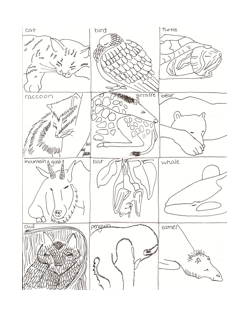
            Make bingo boards using different animals from the animal page.  6-8 per board is a good amount for young children. Make a copy of the animal page to use for the call cards.  Play until everyone gets bingo.  Can the children name the different kinds of animals?

Social & Emotional Development/Cooperation; develops increasing abilities to give and take in interactions; to take turns in games and using materials; and to interact without being overly submissive or directive. AND Approaches to Learning/Engagement & Persistence; grows in abilities to persist in and complete a variety of tasks, activities, projects, and experiences.

Outdoor Pay

            Play sleepy tag.  The teacher tries to catch the children.  The children can drop to the ground and pretend to be asleep.  If the teacher catches a child before they fall asleep, they must go to the bed (a designated tree or bench on the playground).  If another child who is not in the bed touches the bed, all the children in it may run free.  The game continues until the teacher is exhausted.

Physical Health & Development/Health Status & Practices; participates actively in games, outdoor play, and other forms of exercise that enhance physical fitness.

Transitions

Hold up one of the BINGO cards and ask the children to name and then act out how that animal sleeps.

Creative Arts/Dramatic Play; participates in a variety of dramatic play activities that become more extended and complex.

Resources

New Shoes for Silvia, by Johanna Hurwitz

            Silvia receives a pair of shoes in the mail but they are too big.  She must wait for the shoes to fit her feet.  Until then, she thinks of many ways to use her shoes.

Materials

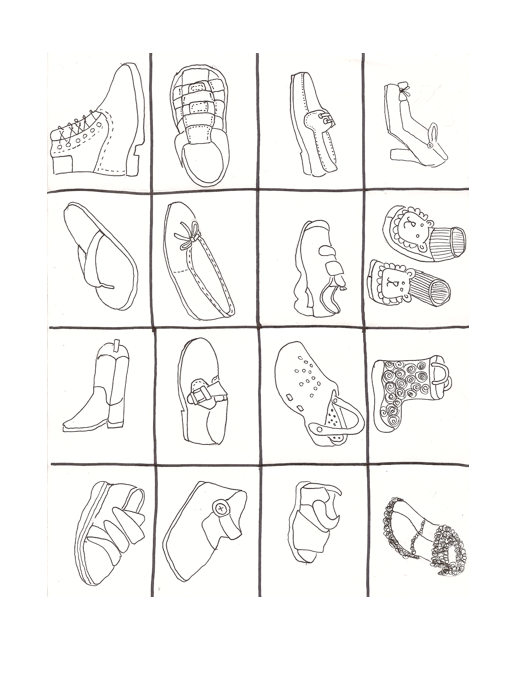
  • Shoe design for shoe match game
  • A variety of boxes from small to shoe bow size
  • Picture of a large shoe for each child
  • Several towels to dry feet

Vocabulary

  • Pair (two similar things that are used together)
  • Sole (bottom of the shoe)
  •  Tia (the Spanish word for Aunt)
  •  Oxen ( a kind of cow that is used to pull a wagon)

Before Reading the Story

            Bring in a box with a pair of shoes inside.  Keep the box closed and have the children try to guess what is inside the box.  (There’s a pair of something in here.  They have tongues and 6 eye holes each.  They are made out of rubber and have a sole.  They come in many colors but these are white with stripes).

Approaches to Learning/Reasoning & Problem Solving; develops increasing abilities to classify, compare, and contrast objects, events, and experiences.

Reading the Story

            Take your time on each page and talk about how life in Silvia’s home looks different then life in the US.

Social & Emotional Development/Knowledge of Families & Communities; progresses in understanding similarities and respecting differences among people, genders, race, special needs, culture, language, and family structures.

After Reading the Story

            Recall with the children all the things Silvia did with her shoes while she was waiting for her feet to grow.  Ask the children if they can think of any other things they could do with the shoes if they were waiting.  Ask the children if they remember what color Silvia’s shoes were. 

Approaches to Learning/Initiative & Curiosity; approaches tasks and activities with increased flexibility, imagination, and inventiveness.

Make a simple graph that shows the colors of the shoes that the children are wearing today.

Mathematics/Number & Operations; begins to associate number concepts, vocabulary, quantities, and written numerals in meaningful ways.

Discovery

            Explain to the children that many shoes have a design on the sole of the shoe.  Have the children put a thin piece of paper over the bottom of the shoe and use the side of a crayon to do a shoe rubbing.  When they are finished, hang the rubbings on the wall.  Can the children tell which shoe belongs to them?  Do they see any letters or shapes? 

Approaches to Learning/Reasoning & Problem Solving; grows in recognizing and solving problems through active exploration, including trial and error, and interactions and discussions with peers and adults. AND Literacy/Alphabet Knowledge; knows that letters of the alphabet are a special category of visual graphics that can be individually named.

Music and Movement

            Have each child take off one of their shoes and place them in a pile in the middle of the circle.  The teacher takes one shoe and begins to sing, we will pass this shoe from me to you to you.  We will pass the shoe and that’s just what we’ll do.  The shoe gets passed around the circle until it arrives at the child to whom it belongs.  The child then puts it behind his back and another shoe gets passed.

Social & Emotional Development/Self-Concept; begins to develop and express awareness of self in terms of specific abilities, characteristics, and preferences.

            Teach the children the poem, One, Two, Buckle My Shoe. Have the children hold up the correct amount of fingers as you do the poem.

1,2 buckle my shoe

3,4 shut the door

5,6 pickup sticks

7,8 lay them straight

9,10 begin again

Mathematics/Number & Operations; develops increasing ability to count in sequence to 10 and beyond.

Blocks

If you are able to collect a variety of boxes, add them to the block center today for extra building materials. (Think cereal, shoe, jewelry, and food boxes. If you choose to make these permanent parts of your block center, stuff them with newspaper and tape them securely shut).

Approaches to Learning/Initiative & Curiosity; approaches tasks and activities with increased flexibility, imagination, and inventiveness.

Art

            Give each child a shoe shape and have them decorate it any way they choose.  Offer glitter, water colors, stickers, and fun collage materials to decorate their shoe.

Creative Arts/Art; develops growing abilities to plan, work indepently, and demonstrate care and [persistence in a variety of art projects.

Library and Writing

            On a half a sheet of paper write a large number 1.  Continue on halves of paper writing the numbers 1-10.  Give the children shoe laces or pieces of yarn and show them how to lay the shoe lace over the numbers.  You can also let the children use play dough to cover the numbers.

Mathematics/Number & Operations; begins to associate number concepts, vocabulary, quantities, and written numerals in meaningful ways.

Sand and Water

If possible, put your water table on the floor and let the children take turns splashing around in shallow water. After they have had their turn, encourage them to put their shoes on by themselves.

Social & Emotional Development/Self-Control; demonstrates increasing capacity to follow rules and routines and use materials purposefully, safely, and respectfully. AND Physical Health & Development/Health Status & Practices; shows growing independence in hygiene, nutrition, and personal care when eating, dressing, washing hands, brushing teeth, and toileting.

Dramatic Play

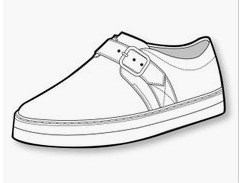
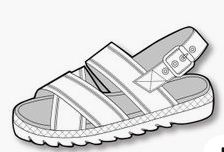
            Encourage shoe play today.  Bring in a variety of shoes in various sizes.  Add a ruler or shoe-measuring device so the children can see how big their foot is.  Make sure to have at least on pair that requires lacing so the children can practice.  Ask the children to put the shoes in order from smallest to largest.

Mathematics/Patterns & Measurement; shows progress in using standard and non-standard measures for length and area of objects. AND Shows increasing abilities to match, sort, put in a series, and regroup objects according to one or two attributes such as color, shape, or size.

Math and Manipulatives

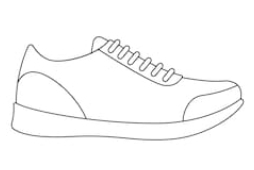
            Make several sets of the shoes page that the children can use to match. If you make several sets then they will match not only the shoe shape but the colors.

Mathematics/Geometry Spatial Sense; shows growth in matchng, sorting, putting in a series, and regroup objects according to one or two attributes such as color, shape, or size. 

Outdoor Play

            As the children run and play, remind them that their shoes are helping to protect their feet from sharp objects.  Also keep a close eye for shoes that are untied or unbuckled/unvelcro.  Explain that it is important so that they will not trip and fall.

Physical Health & Development/Health Status & practices; builds awareness and ability to follow basic health and safety rules such as fire safety, traffic and pedestrian safety, and responding appropriately to potentially harmful objects, substances, and activities.

Transitions

            Silvia’s shoes were red.  As the children go to the next activity can they name red things?  When you have exhausted one color, go to another.

Approaches to Learning/Reasoning & Problem Solving; develops increasing ability to find more than one solution to a question, task, or problem.

Resources