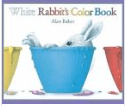
White Rabbit’s Color Book, by Alan baker

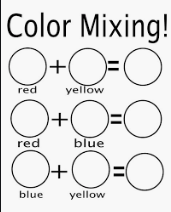
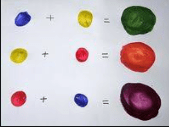
                  White Rabbit explores color mixing by jumping in and out of buckets of paint.  This is a nice first story about primary and secondary colors.

Materials

  •  Food coloring, red, blue, and yellow
  •  Empty clear plastic water bottles
  • Spray bottle of water
  • Paint samples (can get free anywhere paint is sold)
  • Playdough recipe and ingredients, see Discovery

Vocabulary

  • Quick dip (to go for a quick swim)
  • Royal (to be a king or queen, prince, or princess)

Before Reading the Story

Ask the children to show you a color that they are wearing. (Who’s wearing red? I see green on Mabel’s skirt, Mabel can you show us the green?),

Language Development/Listening & Understanding; demonstrates increasing ability to attend to and understand conversations, stories, songs, and poems.

Reading the Story

                  Make sure to stop along the way so the children can guess what new color rabbit will be.

Approaches to Learning/Reasoning & Problem Solving; grows in recognizing and solving problems through active exploration, including trial and error, and interactions and discussions with peers and adults.

After Reading the Story

                  Fill the plastic water bottles up with water.  At the rug, drop several drops of red food coloring into the bottle.  Now add several drops of blue, what happens?  Do this mixing red, yellow, and blue food coloring in various ways.  Let the children guess as you work.

Science/Scientific Skills & Methods; begins to use senses and a variety of tools and simple measuring devices to gather information, investigate materials and observe natural processes.

Discovery

                  Make play dough with the children today.  (Mix together well; 1 cup white flour, .5 cup table salt, 2 Tbls. Veggie oil, 1 tsp alum.  In a small cup add .5 cup of warm water and food coloring to make color of choice).  Have the children each mix their own and choose their own color play dough.  Keep these in small ziplock baggies that are airtight.

Science/Scientific Skills & Methods; begins to participate in simple investigations to test observations, discuss and draw conclusions, and form generalizations.

Music and Movement

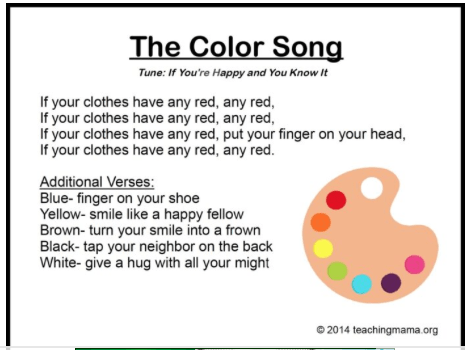
Play the Color Song by Hap Palmer, have the children hold up sheets of colored construction paper and follow the songs directions. https://www.youtube.com/watch?v=4v-nocdm20g
Language Development/Listening & Understanding; shows progress in understanding and following simple and multiple-step directions.

Blocks

Put out small colored blocks today for the children to build with. As they work comment upon their structures. (I see you used that tall red block on top, What color block will you use next? You are making a pattern of red, blue, red, blue-good for you!, How many square yellow clocks did you need to use to make that wall?).

Mathematics/Geometry & Spatial Sense; begins to recognize, describe, compare, and name common shapes, their attributes and parts. AND Approaches to Learning/Engagement & Persistence; shows growing capacity to maintain concentration over time on a task, question, set of directions or interactions, despite distractions or interruptions.

Art

                  Today would be a good day to finger paint with red, yellow, and blue. (If you do finger painting on cookie sheets you can do your major clean-up later in the day).

Creative Arts/Art; begins to understand and share opinions about artistic products and experiences.

Library and Writing

                  Have the child spray a piece of construction paper with water from a spray bottle until paper is dampened.  Then have them write their name or draw on the wet paper with magic markers.  The colors will bleed from the water and make new colors where they touch.

Literacy/Early Writing; progresses from scribbles, shapes, or pictures to represent ideas , to using letter-like symbols, to copying or writing familiar words such as their own name.

Sand and Water

                  Put water into the table today and add some food coloring to make the color the child asks for.

Social & Emotional Development/Self-Control; demonstrates increasing capacity to follow rules and routines and use materials purposely, safely, and respectfully.

Dramatic Play

Math and Manipulatives

                  Collect paint samples in various colors.  Make sure to get two of each color sample.  Put them in a bowl and let the children sort and match them.  For younger children gather a variety of colors, for older children try various shades of the same or similar colors.

Mathematics/Patterns & Measurement; shows increasing abilities to match, sort, put in a series, and regroup objects according to one or two attributes such shape, sixe, or color.

Outdoor Play

Bring out a sheet of green and red construction paper and play Red Light, Green Light. The children stand on one side of the playground and the teacher on the other. The teacher turns her back to the children and holds up the green paper shouting Green Light! The children move towards the teacher. The teacher then holds up the red paper and shouts Red Light! and turns around quickly. If any children are seen moving, they must go back to the starting point. The object is to reach the teacher following the red light, green light prompts.

Language Development/Listening & Understanding; shows progress in understanding and following simple and multiple-step directions.

Transitions

                  Play I Spy using colors.  I spy with my little eyes something on the block shelf that is red and has black wheels.  I spy with my little eyes someone who is wearing a green and white flowered shirt. Let the children take turns guessing as they move onto the next activity.

Language Development/Listening & Understanding; understands an increasingly complex and varied vocabulary. AND Approaches to Learning/Reasoning & problem Solving; develops increasing abilities to classify, compare,and contrast objects, events, and experiences.

Resources

Idea for finger painting.
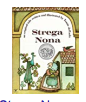
Strega Nona, by Tomie dePaola

                  What happens when Big Anthony does not listen to Strega Nona and does what she asks him not to? 

Materials

  • A box of cooked spaghetti
  • Several different kinds of pasta that can be strung
  • Box of cornstarch
  • Two to three cookie sheets

Vocabulary

  •                   Pasta (another name for fancy noodles)
  •                   Grazie (thank you in Italian)
  •                   Confess (tell the truth)
  •                   Hero (someone who everyone admires and thinks is cool)

Before Reading the Story

                  Talk with the children about the importance of listening to adults.  Why do you think they make rules for children?  Have you ever disobeyed your parent, what happened?  Explain that the story today is about a boy named Anthony who did not listen when an adult told him not to touch something.

Reading the Story

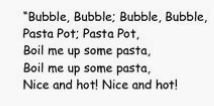
Sing song Strega Nona’s directions to the pot. Encourage the children to hum along with you. There is a great reading of this story on You Tube https://www.youtube.com/watch?reload=9&v=PGVXwMX0e5w.

After Reading the Story

                  Ask the children if they can recall some of the jobs that Big Anthony does for Strega Nona.  Ask them if they ever help anyone at home or school?  What kinds of jobs do they do for others?  List on a piece of paper.

Language Development/Speaking & Communicating; develops increasing abilities to understand and use language to communicate information, experiences, ideas, feelings, opinions, needs, questions; and for other varied purposes.

Discovery

                  Put out cookie trays with a cornstarch and water mix.  Put the cornstarch onto the tray and slowly add small amounts of water.  You will know when the consistency is correct because you can scoop up the cornstarch mix in your hand but then the warmth of your skin makes it sort of melt between your fingers.  Let the children experiment with this mix.  Can they write their name in it?  Talk about the cause and effect.

Literacy/Early Writing; progresses from scribbles, shapes, or pictures to represent ideas, to using letter-like symbols, to copying or writing familiar words such as their own name. AND Science/Scientific Skills & Methods; begins to use senses and a variety of tools and simple measuring devices to gather information, investigate materials, and observe processes and relationships.

Music and Movement

Sing the Pasta Pot song to the tune of Are You Sleeping? https://www.youtube.com/watch?v=YVnmz2t5q-k

Blocks

Encourage the children to build Strega Nona’s house. The children can build it and then destroy it pretending that they are the pot of spaghetti.

Approaches to Learning/Initiative & Curiosity; approaches tasks and activities with increased flexibility, imagination, and inventiveness.

Art

                  Cut pieces of yarn about 8 inches long.  The children can dip these into bowls of paint and then drag across a piece of paper. Add a spoon to the bowl of paint to help the children with dipping the yarn.

Physical Health & Development/Fine Motor Skills; develops growing strength, dexterity, and control needed to use tools such as scissors, paper punch, stapler, and hammer. AND Creative Arts/Art; gains ability in using different art media and materials in a variety of ways for creative expression and representation.

Sand and water

                  If you center allows you to use food, add cooked noodles to the table.  How do they feel? 

Approaches to Learning/Initiative & Curiosity; chooses to participate in an increasing variety of tasks and activities.

Library and Writing

                  Use cooked pasta or pieces of yarn (pretend spaghetti) to draw letters and shapes with.  You can draw the child’s name on a large piece of paper and the child can take glue, cover the lines and then attach yarn on top.

Physical Health & Development/Fine Motor Skills; progresses in abilities to use writing, drawing, and art tools, including pencils, markers, chalk, paint brushes, and various types of technology.

Dramatic Play

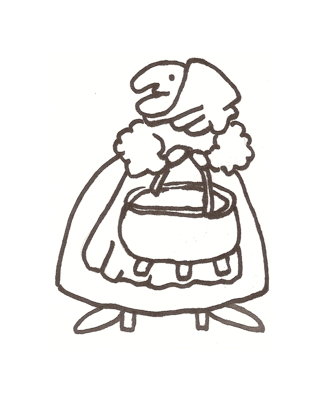
                  Add a large pot to the center today and the children can act out the story.  What else can you cook in your magic pot? Also add a kerchief and a small apron if available. Hang the picture of Strega Nona in the center.

Literacy/Book Knowledge & Appreciation; demonstrates progress in abilities to retell and dictate stories from books and experiences; to act out stories in dramatic play; and to predict what will happen next in a story.

Math and Manipulatives

                  Bring in several different kinds of pasta that the children can string.  Can they make a pattern with their pasta?

Mathematics/Patterns & Measurement; enhances abilities to recognize, duplicate, and extend simple patterns using a variety of materials. AND Physical Health & Development/Fine Motor Skills; grows in hand-eye coordination in building with blocks, putting together puzzles, reproducing patterns and shapes, stringing beads, and using scissors.

Outdoors Play

                  Weather permitting, give the children large buckets and add dirt, water, pine needles, rocks, sand, etc.  Make bubbling pots of whatever.

Literacy/Book Knowledge & Appreciation; demonstrates progress in abilities to retell and dictate stories from books and experiences; to act out stories in dramatic play; and to predict what will happen next in a story.

Transitions

                  Re-read the magic chants that Strega Nona said to the pot.  Ask the children if they can name the rhyming words.  As the children go to the next activity, give them a word and ask them if they can make a rhyming word for it.

Literacy/Phonological Awareness; progresses in recognizing matching sounds and rhymes in familiar words, games, songs, stories, and poems.

Resources

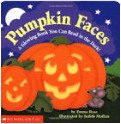
Pumpkin Faces, by Emma Rose

                  This very simple text helps children be aware of faces.  This is a cute book to begin a discussion about emotions and also to give the children ideas for drawing their own pumpkin faces.

Materials

  • A pumpkin shape from poster board or paper plate with holes punched out about ¼ inch from the edge and ½ inch apart all the way around.                 
  • Ribbon or yarn                 
  • 2 or 3 pumpkins.
  • Metal Spoons for scooping a pumpkin

Vocabulary

  • Jack-o-lantern (a pumpkin that someone has made a face on)
  • Naming a variety of emotions
  • Emotions (the different ways that you feel during the day)

Before Reading the Story

                  Bring a pumpkin to the carpet and ask the children what it is.  Find out what they know about pumpkins.  Do pumpkins grow in trees?  What do you think is inside of a pumpkin?  I wonder if they ever grow purple pumpkins?  Roll the pumpkin around the circle.  Can you think of other things that you can roll?

Language Development/Speaking & Communicating; develops increasing abilities to understand and use language to communicate information, experiences, ideas, feelings, opinions, needs, questions; and for other varied purposes. AND Science/Scientific Knowledge; expands knowledge of and abilities to observe, describe, and discuss the natural world, materials, living things, and natural processes.

Reading the Story

                  As you read, go slowly to see if the children can interpret the pumpkin face and name before you read the word.

Language Development/Speaking & Communicating; develops increasing abilities to understand and use language to communicate information, experiences, ideas, feelings, opinions, needs, questions; and for other varied purposes.

 After Reading the Story

Enlarge copies of 3-5 pumpkin faces. Hold one up and ask the children if they can tell you what feeling the pumpkin is representing. Then ask them to share something that makes them feel that way. (I get scared when my Dad turns off the light at night. I feel proud cause I can ride my bike with two wheels. I was mad cause my sister took my toy and threw it on the ground and it broke).

Language Development/Speaking & Communicating; develops increasing abilities to understand and use language to communicate information, experiences, ideas, feelings, opinions, needs, questions; and for other varied purposes.

Discovery

                  Put a pumpkin into the science center.  Cut the top so the children can begin to pull the guts out and explore the pumpkin using all of their senses. If the children are hesitant to putting their hands inside the pumpkin, cut the pumpkin in half so that it is easier and less gooey to scoop. As the children work, write down their responses to how it feels, smells, tastes, what did you find inside, how does the outside feel, etc..

Science/Scientific Skills & Methods; develops growing abilities to collect, describe, and record information through a variety of means including discussion, drawings, maps, and charts.

Music and Movement

              Sing, If You’re Happy and You Know It.  Sing using different emotions with each verse.  Have the children make the facial and body language to go with each emotion.

Language Development/Listening & Understanding; demonstrates increasing ability to attend to and understand conversations, stories, songs, and poems.

Teach the children the poem, Scary Eyes.

See these big and scary eyes, (Make two circle with hands and put around eyes) It’s a Halloween Surprise. BOO! (Wait a beat and then Pop hands away from eyes)

Language Development/Listening & Understanding; demonstrates increasing ability to attend to and understand conversations, stories, songs, and poems.

Blocks

                  Encourage the children to build ramps and then find things that they will roll down. Have the children sort things that roll and do not roll. Can they tell what all the rolling objects have in common? (roundness)

Science/Scientific Skills & Methods; begins in simple investigations to test observations, discuss and draw conclusions, and form generalizations.

 Art

                  Put large pumpkin shapes at the easel.  The children can paint pumpkins or try to make a jack-o-lantern face.

Creative Arts/Art; progresses in abilities to create drawings, paintings, models, and other art creations that are more detailed, creative, or realistic. AND Physical Health & Development/Fine Motor Skills; progresses in abilities to use writing , drawing, and art tools, including pencils,markers, chalk, paint brushes, and various types of technology.

 Library and Writing

                  Play the Pumpkin Memory game.  The children find pairs of pumpkins and then must name the emotion and something that would make them feel that way.

Mathematics/Patterns & Measurement; shows increasing abilities to match, sort, put in a series, and regroup objects according to one or two attributes such as shape or size. AND Approaches to Learning/Engagement & Persistence; grows in abilities to persist in and complete a variety of tasks, activities, projects, and experiences.

 Sand and Water

                  Do a float and sink experiment today.  Fill the water table up with water and then ask the children if they think a pumpkin will float or sink.  Put a pumpkin into the table and see what happens.  Encourage the children to explore further float and sink .

Science/Scientific Skills & Methods; begins to participate in simple investigations to test observations, discuss and draw conclusions, and form generalizations.

 Dramatic Play

If you have old Halloween costumes you could put them in the center for the children to experience with. (I have found that children like old hats and wigs also but you must make sure that no one has lice in your classroom).

Approaches to Learning/Initiative & Curiosity; chooses to participate in an increasing variety of tasks and activities.

 Math and Manipulatives

                  Give each child a pumpkin shape with holes punched out all around the edges.  Show the children how to lace the ribbon through the holes to go around the pumpkin.  When the child has finished lacing the pumpkin, encourage them to draw a face.

Physical Health & Development/Fine Motor Skills; grows in hand-eye coordination in building with blocks, putting together puzzles, reproducing shapes and patterns, stringing beads, and using scissors. AND Creative Arts/Art; progresses in abilities to create drawings, paintings, models, and other art creations that are more detailed, creative, or realistic.

Outdoor Play

                  Practice rolling on the grass.

Physical Health & Development/Health Status & Practices; progresses in physical growth, strength, stamina, and flexibility.

 Transitions

                  Let each child pick a pumpkin face card and act out the expression.  Can the other children guess what emotion the child is trying to express?

Approaches to Learning/Reasoning & Problem Solving; grows in recognizing and solving problems through active exploration, including trial and error, and interactions and discussions with peers and adults.

Resource