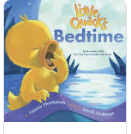
Little Quack’s Bedtime, by Lauren Thompson

            It’s time for 5 little ducklings to go to bed but what are all those frightening sights and sounds?  Mamma Duck helps her family get settled for the night, it’s time for bed.

Materials

  • Star stickers
  • Tape recording of quiet but familiar household sounds that children might hear at night (clock ticking, ceiling fan motor, faucet dripping, cat meow, someone snoring)
  • On a piece of large dark paper, trace around familiar classroom objects.  Put the objects you traced around into a basket and use for the discovery center today.
  • Star design (to watercolor)
  •  Quilt pattern
  • 26 index cards with a letter of the alphabet printed and a direction on each.

Vocabulary

  •  Flashing (when something blinks on and off, on and off)
  •  Sway (to swing back and forth)

Before Reading the Story

            Open the book so the children can see both the front and back covers.  Can you tell what this book is about by looking at the illustrations?

Literacy/Book Knowledge & Appreciation; demonstrates progress in abilities to retell and dictate stories from books and past experiences; to act out stories in dramatic play; and to predict what will happen next in a story. AND Approaches to Learning/Reasoning & Problem Solving; grows in recognizing and solving problems through active exploration, including trial and error, and interactions and discussions with peers and adults.

While Reading the Story

            As you read the parts where the ducklings are questioning what is out in the night, add a touch of fear to your voice.

After Reading the Story

            Lead a discussion about how things look and sound different in the night.  Play the night time recording and ask the children if they can guess the sounds that they are hearing. If you cannot make a listening game, there are some general ones on youtube. https://www.youtube.com/watch?v=n1m4h79JZso

Approaches to Learning/Initiative & Curiosity;approaches tasks and activities with increased flexibility, imagination, and inventiveness.

Discovery

            Set out the paper you traced objects around and the basket of objects.  See if the children can match the objects to their shape. For older children make it more challenging by tracing around similar objects (2 duplos, one slightly larger, a spoon and a fork from dramatic play. counting bears in two sizes, etc.)

Mathematics/Geometry & SPatial Sense; begins to determine whether or not two shapes are the same size and shape.

Music and Movement;

            Sing 5 in the bed and the little one said, roll over, roll over. https://www.youtube.com/watch?v=W1_dxT7efcs

Mathematics/Number & Operations;begins to associate number concepts, vocabulary, quantities, and written numerals in meaningful ways.

            Sing Twinkle Twinkle Little Star . Then change the verses to include great big star, teeny tiny star, medium sized star. Hold up hands to indicate what size star you are singing about.

Mathematics/Patterns & Measurement; shows progress in using standard and non-standard measures for length and area of an object.

Blocks

            Can you use the blocks to make beds for the people?  I have 5 people, can you make 5 beds?  Which shape blocks are you using to make the bed?  Can you make a bed big enough for yourself?

Mathematics/Number & Operations; begins to use one-to-one correspondence in counting objects and matching groups of objects. AND Mathematics/Geometry & Spatial Sense; progresses in ability to put together and take apart shapes.

Art

            Use a piece of sentence strip paper as a template to make a crown out of dark paper.   Let the children use sticker stars to decorate, or cut out many stars to glue on.

Physical Health & Development/Fine Motor Skills; develops growing strength, dexterity, and control needed to use tools such as scissors, paper punch, stapler, and hammer.

            Water color on star design

Creative Arts/Art; gains ability in using different art media and materials in a variety of ways for creative expression and representation.

Sand and Water

Library and Writing

            Talk to the children about their bedtime rituals.  Make a list of ways they prepare for bed (I brush my teeth, My Mom tucks me in the blanket, My Dad reads me two stories)

Literacy/Early Writing; begins to represent stories and experiences through pictures, dictation, and in play. AND Social & Emotional Development/Knowledge of Families & Communities; progresses in understanding similarities and respecting differences among people such as genders, race, special needs, culture, language, and family structures.

Dramatic Play

            Encourage night time rituals play.  Bring in blankets, pillows, books.

Literacy/Early Writing; begins to represent stories and experiences through pictures, dictation, and in play. AND Social & Emotional Development/Knowledge of Families & Communities; progresses in understanding similarities and respecting differences among people such as genders, race, special needs, culture, language, and family structures.

Math and Manipulatives

            Cut out many one inch squares and give each child a copy of the Quilt picture.  Make a pattern on your quilt using the squares and ask the children if they can copy it.  Let the children make their own patterns and glue them to their quilt paper

Mathematics/Patterns & Measurement; enhances abilities to recognize, duplicate, and extend simple patterns using a variety of materials.

Outdoor Play

Sit quietly and listen for outside sounds. Can the children name the sounds that they are hearing?

Approaches to Learning/Initiative & Curiosity;approaches tasks and activities with increased flexibility, imagination, and inventiveness.

Bring out your index cards with letters and directions. Mix them up. A child picks one and must name the letter and it’s sound and then the teacher gives the direction for all the children to do. A=answer a question, B= bend down and touch your toes, C= clap your hands loudly, D= dance a silly dance, E= exhale loudly, F= fly like a bird, G= gallop once around the playground, H= hop on one foot for five hops, I=imitate what the teacher does, J= jump in place, K= pretend to kick a ball, L= go limp, M= march with high knees for ten steps, N= nod your head up and down, O= prent to open a present, P= Pound your fist on your thigh, Q= quietly say you name, R=Roar really loudly, S= squat down low, T= twirl around, U= uncover a part of your body, V= pretend to vacuum, W= wave to a friend, Y=yodel old lady o, Z= make a zig-zag line in the air.

Literacy/Alphabet Knowledge; identifies 10 letters of the alphabet, especially those in their own name. AND Literacy/Phonological Awareness; associates sounds with written words, such as different words begin with the same sound.

Transitions

Use the same letter cards as outside but this time ask the child to name the letter and then give a word that starts with that letter.

Literacy/Phonological Awareness; associates sounds with written words, such as different words begin with the same sound.

Resources
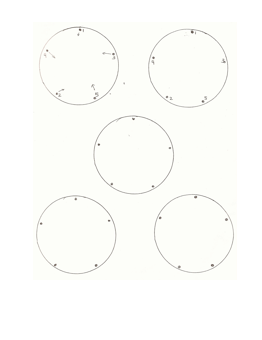
show children how to move from point 1 to point 5 w/o raising the pencil. This will make a star.
Use for art quilts

My Puppy is Born, by Joanna Cole

            This story shows the life of a brand new baby dachshund from birth until it is ready to be adopted.  The photographs are in black and white and show great detail to what a puppy really looks like.

Materials

  • Balance scale
  • Several small dog bones

Vocabulary

  • Nurse (to drink mother’s milk from her breast or nipple)
  • Weak (muscles are not strong enough)
  • Howling (making loud noises)
  • Solid food (food you have to chew)
  • Adopted (to make a new home for a pet or child).

Before Reading the Story

            Ask the children how many of them have a dog at home?  What is a baby dog called?  Did anyone ever have a puppy at home?  What other kinds of pets do the children have?  Ask them about how they must care for their pets, their pet’s names,  and any special things that their pet does.

Science/Scientific Knowledge; expands knowledge of and abilities to observe, describe, and discuss the natural world, materials, living things, and natural processes.

Reading the Story

            Show the children the cover of the book and explain that baby animals must spend time with their mother’s before they can be adopted to a new home. Let’s find out about puppies.

Language Development/Listening & Understanding; demonstrates increasing ability to attend to and understand conversations, stories, songs, and poems.

After Reading the Story

            Ask the children to help you list some things that you know/learned about puppies.  (They are tiny, they get their milk from their Mom, He has cute ears).

Language Development/Speaking & Communicating; develops increasing abilities to understand and use language to communicate information, experiences, ideas, feelings, opinions, needs, questions; and for other varied purposes.

Discovery

 Bring in a balance scale. Fill a sock with sand to weigh 3 ounces.  Give the children manipulatives (cubes, bears, etc) to balance the scale.  How many cubes equal the weight of the baby puppy?

Mathematics/Patterns & Measurement; shows progress in using standard and non-standard measures for length and area of objects. AND Mathematics/Patterns & Measurement; to make comparisons between several objects based on a single attribute.

Music and Movement

            Sing How Much is That Doggie in the Window , First verse only https://www.youtube.com/watch?v=AElJuZJTOdk

How much is that doggie in the window? 

The one with the waggly tail

How much is that doggie in the window?

I do hope that doggies for sale, ruff ruff.

Creative Arts/Music; participates with growing interest and enjoyment in a variety of music activities, including listening, singing, finger plays, games, and performances.

Sing I’ve Got a Dog His https://www.youtube.com/watch?v=XpkRfD9ZFQwName is Rags Have the children do the actions.

I have a dog, his name is Rags

He eats so much that his tummy sags.

His ears flip-flop and his tail wig-wags

And when he walks he goes zig-zag.

He goes flip-flop, wig-wag, zig-zag

He goes flip-flop, wig-wag. Zig-zag

He goes flip-flop. wig-wag, zig-zag

I love Rags and he loves me.

I love Rags and he loves me!

(Make motions to go flip-flop, wig-wag, and zig-zag)

Creative Arts/Music; participates with growing interest and enjoyment in a variety of music activities, including listening, singing, finger plays, games, and performances.

            Have the children try to sing Ruff Ruff to a tune that they know well, for example ABC or Jingle Bells.

Creative Arts/Music; participates with growing interest and enjoyment in a variety of music activities, including listening, singing, finger plays, games, and performances.

Blocks

            Bring in any small dog toys you may have and encourage the children to build a dog house with a fence around it.

Social & Emotional Development/Cooperation; increases abilities to sustain interactions with peers by helping, sharing, and discussion.

Art     

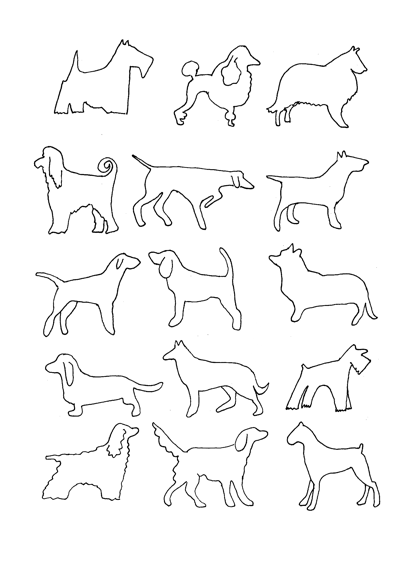
Give each child a copy of the ‘dog’ page.  Ask them to cut around each dog and then glue them to a sentence strip in a line.  They can decorate the dogs if they choose. If you staple the sentence strip these can be worn as dog crowns.

Physical Health & Development/Fine Motor Skills; develops growing strength, dexterity, and control needed to use tools such as scissors, paper punch, stapler, and hammer.

Library and Writing

            Ask the children to draw a picture of a pet that they have or a pet that they would like to have.  Have them describe their pet and write their dictation down under their illustration.

Literacy/Early Writing; begins to represent stories and experiences through pictures, dictation, and in play.

Sand and Water

Put dirt or sand into the table today along with several small dog bones. Explain to the children that dogs like to bury bones and then undig them later. Encourage one child to hide/bury the bones in the dirt and the next child to dig up the bones.

Social & Emotional Development/Cooperation; develops increasing abilities to give and take in interactions; to take turns in games or using materials; and to interact without being overly submissive or directive.

 Dramatic Play

            Pet Store Play. Bring in stuffed animals of pets.  Add several boxes or milk crates to be the cages.  The children can either bring pet food containers to school or you could have them make them out of play dough and let them dry.  Don’t forget to use the cash register and money to purchase pet or pet supplies.

Creative Arts/Dramatic Play; shows growing creativity and imagination in using materials and in assuming different roles in dramatic play situations.

Math and Manipulatives

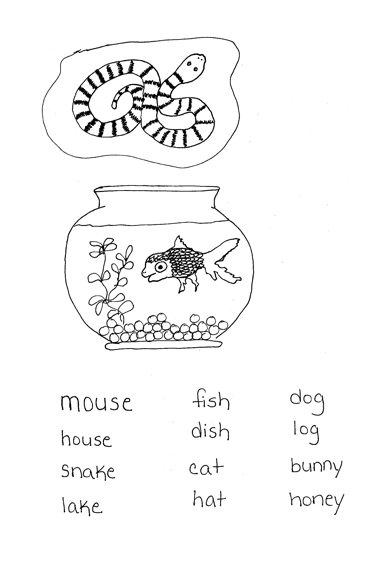
            Copy and cut out the pictures of the animals. Show one at a time to the child and ask them where is the animal? Or ask, what animal is under the hat? Encourage the children to name the animal and a word that rhymes with it.

Mathematics/Geometry & Spatial Sense; builds an increasing understanding of directionality, order, and positions of objects, and words such as up, down, over, under, bottom, inside, outside, in front, and behind. AND Literacy/Phonological Awareness; progresses in recognizing matching sounds and rhymes in familiar words, games, songs, stories, and poems.

Outdoor Play

            On the playground the children can pretend to be dogs.  The teacher can call out dog commands such as roll over, fetch (throw a ball), lie down, bark, and sit.  The children can follow the directions.

Language Development/Listening & Understanding; shows progress in understanding and following simple and multiple-step directions.

 Transitions

            Ask the children to think of a good dog name for themselves.  Challenge older children to think of a name that starts with the same letter sound or has the same amount of syllables as their name.

Literacy/Phonological Awareness; shows growing awareness of beginning and ending sounds of words.

Resources

Miss Spider’s Tea Party, the counting book, by David Kirk

            Miss Spider is lonely.  She can not understand why none of the insects want to come to her tea party?  Count the insects as they meet Miss Spider.

Materials

  • Pitcher and about 4-6 decaffeinated fruit tea bags.
  • Crepe paper
  • A spider hung from a string ( this can be stuffed, rubber, or paper)
  • Camera

Vocabulary

  • To dash off (to run off quickly)
  • Tea party ( a party where you drink tea and eat sweets)

Before Reading the Story

            Hang a large piece of paper where all the children can see it.  Ask the children to see if they can guess what you are drawing.  Draw a simple spider on the paper.  When the children have guessed spider, have them count the eight legs with you.  Tell the children that it has to have 8 legs to be a spider. Now draw another spider but only put on 5 legs.  Ask the children if this is a spider?  (No because it only has 5 legs)  Add 3 more.  Do this several times making another spider with 8 legs and two more with more or less legs.  How many legs does a spider have to have?  Tell the children that our story today is about a spider.

Mathematics/Number & Operations; begins to make one-to-one correspondence in counting objects and matching groups of objects. AND Science/Scientific Knowledge; expands knowledge of and abilities to observe, describe, and discuss the natural world, materials, living things, and natural processes.

Reading the Story

            Make sure to take time to let the children help count the insects on each page.

Mathematics/Number & Operations; begins to make one-to-one correspondence in counting objects and matching groups of objects.

On the children the page where Miss Spider is wiping her tears (Miss Spider sobbed, “They’ve all dashed off”).  Ask them why they think all the insects dashed off? (Because spiders eat insects). 

Social & Emotional Development/Social Relationships; progresses in responding sympathetically to peers who are in need, upset, hurt, or angry; and in expressing empathy to others.

After Reading the Story

            Hold up the cover of the book and ask the children did Miss Spider want to eat the insects? (No, she wanted to have a party/tea with them).   Ask have the children ever been to a party?  What kinds of things do you do at a party?    How do you feel when you get to go to a party? (happy, it’s fun, I like to go). 

Literacy/Book Knowledge & Appreciation; demonstrates progress in abilities to retell and dictate stories from books and experiences; to act out stories in dramatic play; and to predict what will happen next in a story. AND Language Development/Speaking & Communicating; develops increasing abilities to understand and use language to communicate information, experiences, ideas, feelings, opinions, needs, questions; and for other varied purposes.

Discovery

            Make sun tea.  Bring in a pitcher and several bags of decaffeinated fruit tea.  Put the tea bags in a full pitcher of water and place in the sun.  Observe it throughout the day as the tea gets darker.  Chill before drinking.  Serve with cookies for afternoon snack.

Science/Scientific Skills & Methods; develops increased ability to observe and discuss common properties, differences, and comparisons among objects and materials.

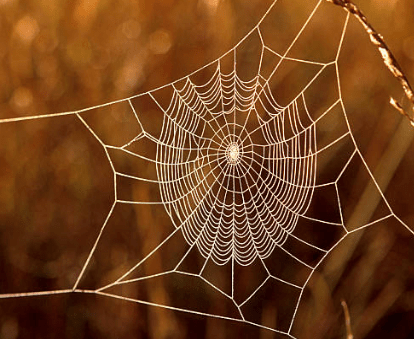
            If you know of any spider web around your school, let the children observe it.  Remind them though to not touch spiders as many bite!

Science/Scientific Skills & Methods; develops increased ability to observe and discuss common properties, differences, and comparisons among objects and materials.

Music and Movement

            Put a pillow out in the center of the circle.  Have a child sit on the pillow and recite the poem, Little Miss Muffit.  Let the children take turns being Miss Muffit or Mr Muffit.  When you get to the part about along came a spider that sat down beside, change to include in front of, behind, and on top of. (dangle a spider prop from a string)

Little Miss/Mr Muffit

Sat on his tuffit/pillow

Eating her/his cottage cheese.

Along came a spider

And sat down (beside) her/him

And frightened Miss/Mr Muffit away.

Language Development/Listening & Understanding; demonstrates increasing ability to attend to and understand conversations, stories, songs, and poems. AND Mathematics/Geometry & Spatial Sense; builds an increasing understanding of directionality, order, and positions of objects, and words such as up, down, over, under, top, bottom, inside, outside, in front and behind.

Blocks

            Ask the children how many legs does a spider have? (8)  Show me something you can build with 8 blocks.

Mathematics/Number & Operations; begins to make one-to-one correspondence in counting objects and matching groups of objects.

Art

            Make spiders out of play dough or clay.  Have the children roll balls out of play dough.  Put out pipe cleaners that have been cut into 1 inch and 2 inch lengths.  Let the children insert the legs into their spiders and put to the side to dry.  When the dough is dry the children can paint their spiders.

Creative Arts/Art; progresses in abilities to create, drawings, paintings, models, and other creations that are more detailed, creative, or realistic.

Library and Writing

            Remind the children why Miss Spider was sad in the story (no one would come to her party because they were afraid she would eat them).   Ask what did Miss Spider really want to do?  (Have them come for a tea party).  Ask the children what kinds of things they like to do with their friends?  If you have a camera available, you could take pictures of each child doing things they like with their school friends and make it into a class book. If you do not have a camera, encourage the chhildren to draw their friends.

Social & Emotional Development/Social Relationships; shows progress in developing relationships with peers.

Sand and Water

            Bring in grass cuttings from the playground or home.  Also add several sticks, stumps, and rocks.  Add plastic insects to the table.  Let the children arrange an insect habitat.

Science/Scientific Skills & Methods; begins to use senses and a variety of tools and simple measuring devices to gather information, investigate materials, and observe processes and relationships. AND Creative Arts/Dramatic Play; participates in a variety of dramatic play activities that become more extended and complex.

Dramatic Play

            Hang some crepe paper and encourage the children to have a party.

Creative Arts/Dramatic Play; participates in a variety of dramatic play activities that become more extended and complex.

Math and Manipulatives

            Give each child a piece of paper.  Ask them to fold the paper in half.  On one side help them write Spider and on the other help them write Insect.  Remind the children that main character in the story was a spider.  How many legs does a spider have? (8).  Have the children draw a spider on the side of the paper that says spider.  Ask them if they know the scientific name for all the other bugs in the story (insects).  Tell the children that all insects have 6 legs.  Have the children draw an insect on the side of the page that says insect.  Encourage the children to write the numbers 8 and 6 on the corresponding sides of the page.

Mathematics/Number & Operations; begins to make one-to-one correspondence in counting objects and matching groups of objects. AND Literacy/Early Writing; begins to represent stories and experiences through pictures, dictation, and in play.

Outdoor Play

            Bring some crepe paper outside and give the children 3 foot sections and show them how to weave it in and out through the fence.

Physical Health & Development/Fine Motor Skills; grows in hand-eye coordination in building with blocks, putting together puzzles, reproducing shapes and patterns, stringing beads, and using scissors.

Transitions

            Ask the children how many legs a spider has?  See if you can get to your next destination in 8 steps.  If not keep counting until you get there.  Ask the next child how many legs an insect has?  Have them count their steps.  Then have all the children count their steps to the next place they are going.

Mathematics/Number & Operations; develops increasing ability to count to 10 and beyond.

Resources